
Many parents become concerned when they notice differences in their child’s communication, social interaction, play, or behaviour. A child may not consistently respond when their name is called, use fewer gestures, have delayed speech, avoid eye contact, repeat certain movements, or prefer playing with toys in a particular way.
This can lead to an important question: Does my child have Autism?
The answer cannot be determined from one behaviour alone. Speech delay, limited eye contact, or not responding to a name does not automatically mean a child has Autism Spectrum Disorder (ASD). Autism is identified by looking at a broader pattern of social communication, interaction, repetitive behaviours, sensory responses, and developmental history.
Understanding the Early signs of autism in children can help parents recognise possible developmental concerns and seek appropriate professional guidance when needed.
What Is Autism?
Autism Spectrum Disorder (ASD) is a neurodevelopmental condition that can affect how a child communicates, interacts with others, learns, plays, and responds to their surroundings.
Autism is called a “spectrum” because it can look different from one child to another. Some children may have significant communication difficulties, while others may speak fluently but experience challenges with social communication, understanding social situations, flexible behaviour, or sensory processing.
Therefore, there is no single behaviour that can identify Autism.
Parents should consider the child's overall developmental pattern, including:
Social interaction
Communication and language
Gestures and shared attenti
Play and imagination
Repetitive behaviours
Sensory responses
Adaptation to changes
Everyday functioning
About Dr. Ankush Garg

Dr. Ankush Garg is an Autism, ADHD, Child Development & Mental Health Specialist in India, Founder of Manovaidya and Creator of the Neuro-Ayurveda Development System.
His approach focuses on understanding individual developmental, behavioural, and mental wellness concerns through personalized guidance, family-centred support, and an understanding of the child's overall needs.
1. Limited Response to Name and Social Interaction
One of the areas parents may notice early is how their child responds to people.
For example, does your child frequently fail to respond when their name is called? Do they rarely look toward a parent's face? Do they show fewer social smiles or seem less interested in sharing experiences with others?
Consider a simple example: a child sees an airplane in the sky. Does the child look at the airplane and then look back at their parent to share the experience, or do they remain focused only on the object?
This type of shared attention is an important part of early social communication.
However, not responding to their name occasionally does not mean a child has Autism. Hearing difficulties, attention differences, language difficulties, and other developmental factors can also affect how a child responds.
When several social communication differences occur together and continue over time, they may be considered among the early signs of autism in children.
2. Limited Pointing, Gestures, or Showing
Communication starts before spoken language develops.
Young children commonly use gestures to communicate, such as:
Waving goodbye
Pointing toward something they want
Raising their arms to be picked up
Showing a toy to a parent
Directing another person's attention toward something interesting
Pointing is particularly useful for understanding social communication.
For example, a child may point toward a bottle because they want water. Another child may point toward an airplane simply to show their parent something interesting.
This ability to share interest with another person is different from using a gesture only to request something.
Limited pointing, fewer gestures, or difficulty sharing attention can be among the Autism signs in toddlers, particularly when they occur together with other developmental differences.
3. Speech and Meaningful Communication
Speech delay is one of the common reasons parents become concerned about Autism. However, the number of words a child can say is only one part of communication.
It is also important to understand how the child uses language and other forms of communication.
Parents can ask:
Does the child use words or gestures to express needs?
Do they respond meaningfully to questions?
Do they try to share experiences with others?
Do they use language to interact, rather than only repeat words?
Do they repeat the same words or sentences frequently?
Do they repeat lines from cartoons without using them appropriately in conversation?
Some children repeat words or phrases they have heard. This is known as echolalia. Echolalia can occur in autistic children, but it does not independently confirm Autism.
The important question is not only:
Can my child speak?
It is also:
“How does my child use communication to connect and interact with other people?”
4. Differences in Play
A child's play behaviour can provide useful information about their development.
For example, a child may enjoy a toy car by driving it around, creating pretend situations, or involving another person in play. Another child may remain highly focused on spinning the wheels or repeatedly arranging the cars in a particular order.
Some children may also show limited functional or imaginative play, such as difficulty with:
Feeding a doll
Pretending to play doctor
Using a block as a pretend phone
Creating simple imaginary situations
Joining another person in play
Every child has their own style of play, so one unusual play behaviour does not diagnose Autism.
However, repetitive play, limited pretend play, or a strong preference for using objects in the same way can become relevant when they occur alongside social communication and behavioural differences.
5. Repetitive Behaviours and Difficulty With Change
Some children repeatedly perform particular movements or activities.
These may include:
Hand flapping
Rocking the body
Spinning
Repeated jumping
Spinning objects
Repeating particular actions
Some children may also prefer routines and become distressed when familiar patterns change.
For example, a child may strongly prefer:
Following the same route
Eating from the same plate
Wearing particular clothes
Following a specific sequence of activities
Repetitive behaviours are not automatically a sign of Autism. They become more relevant when they are persistent, occur together with other developmental differences, or significantly affect communication, learning, relationships, or everyday functioning.
6. Sensory Differences
Sensory responses can also be different in some autistic children.
A child may be highly sensitive to sounds such as:
Vacuum cleaners
Mixers or blenders
Pressure cookers
School bells
Crowded or noisy environments
Some children may react strongly to particular clothing textures, haircuts, nail cutting, smells, or food textures.
Others may actively seek sensory experiences such as spinning, jumping, constant movement, or pressure.
Sensory differences can occur in Autism, but sensory sensitivity alone does not mean a child has Autism. They need to be considered alongside the child's communication, social interaction, behaviour, and developmental history.
7. Loss of Previously Developed Skills
A particularly important developmental concern is when a child loses skills they previously had.
For example, a child who previously:
Used certain words
Responded to their name
Used gestures
Made social connections
Interacted more frequently
may later show a noticeable reduction in these abilities.
Developmental regression should not simply be ignored or assumed to resolve by itself. Parents should discuss any loss of previously developed skills with a qualified healthcare or developmental professional as soon as possible.
Autism Symptoms in Toddlers: What Parents May Notice
The Autism symptoms in toddlers can vary considerably from one child to another. Parents may notice differences in social communication, gestures, play, repetitive behaviours, sensory responses, or flexibility.
Possible concerns include:
Limited response to name
Reduced pointing or gesturing
Limited sharing of interests
Less social interaction
Delayed or unusual communication
Repetitive play
Repetitive movements
Strong attachment to routines
Unusual sensory responses
Loss of previously acquired skills
Having one of these behaviours does not mean a toddler has Autism. The overall developmental pattern is more important than any single sign.
Signs of Autism in a 2-Year-Old
Parents looking for the signs of autism in 2 year old children should pay attention to the child's overall communication, social interaction, play, and behaviour rather than focusing on one symptom.
Possible developmental concerns around age two may include:
Limited meaningful communication
Limited pointing or showing
Reduced response to name
Difficulty sharing attention with parents
Limited interest in interactive play
Repetitive movements or play
Strong distress around changes in routine
Unusual sensory responses
Difficulty using communication to interact socially
A two-year-old may develop skills at a different pace from another child. Therefore, these observations should be discussed with a qualified professional rather than being used as an at-home diagnosis.
Signs of Autism in a 3-Year-Old
The signs of autism in 3 year old children may become more noticeable as social and communication expectations increase.
Possible concerns can include:
Difficulty participating in back-and-forth conversation
Limited interest in playing with or interacting with others
Difficulty with pretend or imaginative play
Repetitive speech or phrases
Repetitive movements or activities
Strong preference for routines
Difficulty adapting to changes
Unusual sensory responses
Difficulty understanding or responding to social cues
Some autistic children may have a large vocabulary at this age. Therefore, being able to speak does not by itself rule out Autism.
The way a child uses language for social communication is also important.
Speech Delay vs Autism: What Is the Difference?
Speech delay and Autism are not the same thing.
A child with a speech or language delay may have difficulty developing spoken language but may still actively communicate through gestures, facial expressions, pointing, showing objects, and social interaction.
For example, a child with speech delay may:
Point to what they want
Show objects to parents
Look toward parents for interaction
Use gestures
Enjoy interactive games
Show interest in other children
Try to communicate despite limited speech
In Autism, communication differences may occur together with differences in social interaction, shared attention, play, repetitive behaviours, or sensory responses.
However, similar developmental concerns can occur with hearing difficulties, language disorders, ADHD, global developmental delay, and other developmental conditions.
This is why a proper developmental assessment is important
When Should Parents Seek an Autism Assessment?
Parents should consider discussing their concerns with a qualified healthcare or developmental professional when a child consistently shows several developmental differences, particularly when they affect everyday functioning.
Consider seeking professional guidance if your child:
Consistently does not respond to their name
Uses very few gestures or rarely points
Has significant speech or communication concerns
Shows limited social interaction
Has repetitive behaviours that interfere with daily activities
Has significant sensory difficulties
Has difficulty adapting to changes
Loses previously developed skills
Autism is not diagnosed through a single blood test or brain scan. A professional assessment generally considers developmental history, communication, social interaction, behaviour, play, and other relevant developmental characteristics.
At Manovaidya, developmental concerns are explored by understanding the child's communication, attention, behaviour, sensory experiences, play skills, and overall developmental profile. This broader understanding helps consider the child's individual strengths and areas where support may be needed.
Manovaidya’s Neuro-Ayurveda Development System
Understanding a child's development requires looking beyond a single symptom. At Manovaidya, the Neuro-Ayurveda Development System provides a structured approach that considers different aspects of a child's development and individual needs.
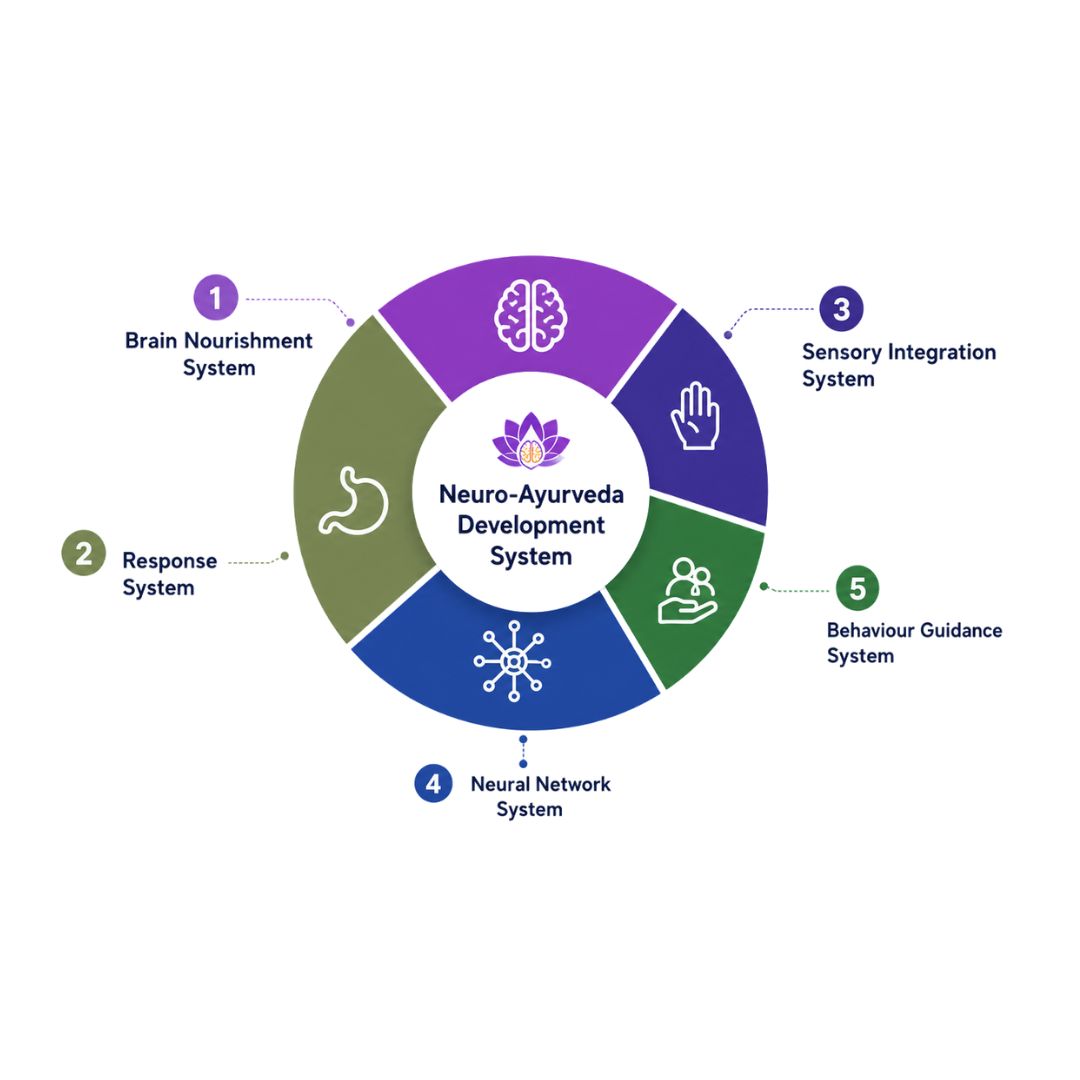
The approach includes five interconnected systems:
1. Brain Nourishment System
This system focuses on the child's overall developmental and brain-related needs as part of an individualized approach.
2. Response System
The Response System considers how a child responds to people, communication, instructions, and different situations in their environment.
3. Sensory Integration System
The Sensory Integration System considers how a child experiences and responds to sensory information such as sounds, touch, movement, textures, and other environmental inputs.
This can be relevant when parents notice sensory differences alongside communication, behavioural, or social concerns.
4. Neural Network System
The Neural Network System considers different aspects of neurological and developmental functioning as part of understanding the child's overall developmental profile.
5. Behaviour Guidance System
The Behaviour Guidance System focuses on behavioural patterns, routines, adaptability, and how a child responds to different situations in everyday life.
A Personalized Approach for Every Child
Every child has different developmental strengths, challenges, communication abilities, and support needs. Therefore, the same approach may not be appropriate for every child.
At Manovaidya, the child's individual developmental profile, communication, behaviour, sensory experiences, and overall needs are considered when planning support. Personalized treatment and customized medicines may be tailored according to individual needs, rather than following exactly the same approach for every child.
The aim is to understand the child more comprehensively and help parents identify appropriate directions for further developmental support.
Why Early Assessment Matters
Understanding the early signs of autism in children is not about trying to diagnose a child at home.
The purpose of an assessment is to understand:
The child's strengths
Areas where additional support may be needed
Communication abilities
Social interaction
Behavioural patterns
Sensory experiences
Developmental needs
Appropriate next steps
Parents do not need to wait until every possible sign appears before discussing a concern.
If several developmental concerns persist or a child loses previously developed skills, seeking professional guidance can help parents understand what may be happening and what steps may be appropriate.
Understanding Your Child Is More Important Than a Label
An Autism assessment is not simply about giving a child a label.
It can help parents understand their child's individual developmental profile and identify areas where support may be useful.
Every child has different strengths, communication abilities, interests, and support needs. A child may need help with communication while having strengths in other areas. Another child may communicate well but experience greater difficulties with social interaction, flexibility, or sensory experiences.
Looking at the whole child provides more useful information than focusing on one behaviour.
Final Thoughts
The most important things parents should remember are:
1. Speech delay does not automatically mean Autism.
Children can experience speech or language delays for many different reasons.
2. One behaviour does not diagnose Autism.
Eye contact, response to name, repetitive play, sensory sensitivity, or speech delay should be understood as part of the child's overall developmental pattern.
3. Early concerns are worth discussing.
When several signs continue over time, affect everyday functioning, or involve a loss of previously developed skills, professional developmental guidance can provide greater clarity.
Recognising the early Signs of autism in children can help parents understand when further evaluation may be appropriate. The goal is not to diagnose a child at home, but to understand their development and identify the right direction for support.
At Manovaidya, the focus is on understanding the child's individual developmental profile and helping parents make informed decisions about appropriate next steps.
Need Guidance?
If you have concerns about your child's communication, behaviour, social interaction, sensory responses, or overall development, professional guidance can help you understand the next steps.
Manovaidya Team
Call: +91-7823838638
Email: manovaidya2@gmail.com
References
World Health Organization (WHO) – Autism
https://www.who.int/news-room/fact-sheets/detail/autism-spectrum-disordersCenters for Disease Control and Prevention (CDC) – Signs and Symptoms of Autism Spectrum Disorder
https://www.cdc.gov/autism/signs-symptoms/index.htmlCenters for Disease Control and Prevention (CDC) – Screening for Autism Spectrum Disorder
https://www.cdc.gov/autism/diagnosis/index.htmlCenters for Disease Control and Prevention (CDC) – Clinical Testing and Diagnosis for Autism Spectrum Disorder
https://www.cdc.gov/autism/hcp/diagnosis/index.htmlNational Institute of Mental Health (NIMH) – Autism Spectrum Disorder
https://www.nimh.nih.gov/health/publications/autism-spectrum-disorderCenters for Disease Control and Prevention (CDC) – About Autism Spectrum Disorder
https://www.cdc.gov/autism/about/index.html