-CrYNDrPl.png)
ADHD Treatment
ADHD Treatment in India: ADHD Assessment, Attention & Child Development Support
Take the first step toward understanding your child's attention, learning and behavioural needs through a structured ADHD Assessment and personalized guidance process.


ADHD Care in India
Core insights
- Understanding Attention Deficit Hyperactivity Disorder
- Common Signs and Symptoms of ADHD
- Inattention, Hyperactivity and Impulsivity
- Understanding ADHD Beyond Behaviour
- ADHD Assessment and Developmental Understanding
- Attention, Learning and Emotional Regulation
- Five-Pillar Neuro-Ayurveda Development System
- Brain Nourishment and Gut Response Support
- Neural Network and Sensory Integration
- Behaviour Guidance and Parent Support
- Manovaidya ADHD Assessment and Support Process
- Healthy Habits and Home Support Strategies
- Personalized Development and Progress Planning
- FAQs About ADHD and Child Development
Want more content like this?
Join our Autism, ADHD and Child Development newsletter for more care tips from our experts.
Your privacy is important to us.
ADHD Treatment in India
ADHD Assessment, Attention & Child Development Support
All children are different and learn, think and grow at their own rate. Some children are naturally active, curious and energetic. Parents look for answers however, when learning becomes impaired or attention is of concern, hyperactivity and/or impulsive behaviour is present, and the individual begins to have problems at school or in daily life.
One of the most frequently seen neurodevelopmental disorders is Attention Deficit Hyperactivity Disorder (ADHD). It may affect focus, attention, behaviour, emotional regulation, learning and functioning in daily life.
At Manovaidya we recognize that ADHD is not just the child being "too active" or "not listening. All aspects of attention, behaviour, learning readiness, emotional wellbeing and overall development are interdependent. That's why we take a holistic approach to the child, rather than just his or her symptoms.
With Dr. Ankush Garg, ADHD, Autism, Child Development & Mental Health Specialist in India, Manovaidya guides families through a structured Neuro-Ayurveda Development System aiming to empower families to understand their child's developmental needs and establish a clear pathway for long-term growth and support.
It doesn't matter if parents are looking for ADHD Treatment in India, ADHD Assessment, Child Development Support or guidance on their concerns of attention and behavior - we aim to provide clarity, structured guidance, and individual support.
Dr. Ankush Garg provides support for ADHD, Autism, Child Development and mental health to families from all over India, Delhi, Noida, Greater Noida, Ghaziabad and NCR with a structured Neuro-Ayurveda Development System.
At Manovaidya, ADHD Support is focused on:
Attention & Focus Development
Learning Readiness & Academic Support
Address student behaviour and emotional regulation.
Support student behaviour and emotional regulation.
Parent Training & Family Support
Brain Development & Cognitive Wellness
Personalized Development Planning
Book an ADHD Assessment
Get started in understanding your child's attention, learning and behavioural needs through an ADHD Assessment and guidance process.
What is ADHD?
Attention Deficit Hyperactivity Disorder (ADHD) is a neurodevelopmental disorder which may affect a child's attention span, behavior control, impulses and organization during activities.
ADHD is not a result of poor parenting, lack of intelligence or a child's unwillingness to listen. It's a condition that affects the way children learn to process information, to focus or to control their behaviour or reactions to the environment; it is developmental.
All children with ADHD are different.
Children may primarily have problems with attention and concentration, or they may be hyperactive or impulsive or have a mixture of these symptoms. ADHD can manifest in different ways for different children.
Many parents first notice concerns when their child:
Struggles to stay focused on tasks
Frequently forgets instructions
Appears easily distracted
Has difficulty sitting still
Interrupts conversations frequently
Faces challenges completing schoolwork
Acts impulsively without thinking through consequences
These behaviours can have a negative impact on academic achievement, family habits, social interactions and self-esteem.
We at Manovaidya feel that an understanding of ADHD cannot be confined to behavior. The areas of attention, emotional regulation, readiness to learn, behaviour, executive functioning and child development can be related to each other.
A developmental understanding with a structure aids families to get out of confusion and frustration and into clarity and action.
Common Signs & Symptoms of ADHD
Signs and symptoms of ADHD may differ for each child depending on their developmental profile, age and individual needs.
Although any child can get distracted or get going from time to time, there are more often children who have a concern that is more persistent and can have an impact on their functioning.
Inattention Symptoms
Children experiencing attention-related challenges may:
Have difficulty concentrating on tasks
Become distracted easily
Frequently forget instructions
Lose personal belongings
Make careless mistakes in schoolwork
Struggle to complete tasks independently
Have difficulty organizing activities
Appear not to listen when spoken to directly
Avoid tasks requiring sustained attention
Frequently shift focus from one activity to another
Parents often describe these children as intelligent but unable to consistently maintain attention.
Hyperactivity Symptoms
A few children with ADHD might be more active than is normal for their age.
Symptoms can include:
Constant movement or restlessness
Difficulty sitting for extended periods
Excessive talking
Fidgeting frequently
Running or climbing in inappropriate situations
Difficulty remaining calm during structured activities
Frequent need for movement
Difficulty waiting patiently
Hyperactivity may sometimes be more apparent in the classroom context, where sitting, concentrating and following routines are required.
Impulsivity Symptoms
Impulsivity is defined as acting impulsively, that is without thoughtful consideration of the consequences.
Examples of common ones are:
Interrupting conversations
Answering questions before they are completed
Difficulty waiting for turns
Acting without thinking
Emotional outbursts
Difficulty controlling immediate reactions
Risk-taking behaviour
Challenges following structured rules
Impulsivity can have an impact on learning, peer relationships, family interactions and emotional regulation.
Understanding ADHD Beyond Behaviour
One of the most common misconceptions about ADHD is that it is simply a behaviour problem.
Parents are often told:
Your child is lazy.
Your child needs more discipline.
Your child is simply naughty.
Your child will outgrow it.
The ADHD is more than it's superficial appearance, although there may be a visible element with behaviour.
There are interrelated areas of development related to attention, emotional regulation, learning readiness, behaviour, motivation and organization.
For example:
Difficulty maintaining attention may affect learning.
Emotional regulation challenges may influence behaviour.
Executive functioning difficulties may affect planning and organization.
Impulsivity may impact social relationships.
Attention difficulties may influence academic performance.
This wider understanding of development is an integral component of the Neuro-Ayurveda Development System that is adopted at Manovaidya.
Goals are to recognize situations where there may be factors beyond visible behaviours that affect attention, learning, behavior and overall development and, provide clear guidance and a structured plan to support families over time.
ADHD Assessment at Manovaidya
- Attention and concentration abilities
- Learning readiness
- Academic functioning
- Behavioural patterns
- Emotional regulation
- Impulsivity
- Social interaction
- Daily routines and functioning
- Developmental strengths
- Areas requiring support
Every child is special with his/her developmental path.
Parents often spend months or years trying to figure out why their child has a problem paying attention, focusing, learning, behaving or managing their emotions. Children may present as being lazy, not paying attention, stubborn or disobedient when the problem is in fact one of their attention and developmental functioning.
In Manovaidya, the evaluation of ADHD does not just involve the individual symptom, but the whole developmental picture.
The assessment process is designed to help families gain clarity about:
Attention and concentration abilities
Learning readiness
Academic functioning
Behavioural patterns
Emotional regulation
Impulsivity
Social interaction
Daily routines and functioning
Developmental strengths
Areas requiring support
Our aim is not just to highlight the challenges, but to gain a greater understanding of the child's individual developmental profile and to design a structured plan for future development and support.
What Does the Assessment Process Include?
- Attention and concentration abilities
- Learning readiness
- Academic functioning
- Behavioural patterns
- Emotional regulation
- Impulsivity
- Social interaction
- Daily routines and functioning
- Developmental strengths
- Areas requiring support
Detailed Parent Discussion
Often parents notice developmental patterns before anyone else.
This is why the assessment process starts with understanding:
Developmental history
School-related concerns
Attention challenges
Behavioural observations
Learning patterns
Emotional responses
Daily routines
Sleep habits
Food preferences
Family observations
This information contributes to the understanding of the child's developmental capacities as a whole.
Understanding Attention & Learning Patterns
The impact of ADHD on learning, behavior and activities of daily living varies.
The assessment process is used to identify:
Attention strengths and challenges
Learning readiness
Behaviour patterns
Emotional regulation abilities
Organizational skills
Social functioning
Academic difficulties
This developmental awareness assists families to transition from confusion to understanding.
Individualized Guidance
Families are provided with systematic input when they have grasp of the child's developmental profile, about what might come next.
This may include:
Behaviour support strategies
Learning support recommendations
Routine development strategies
Emotional regulation support
Progress monitoring approaches
The aim is to offer practical and meaningful guidance that is specific to the child's needs.
ADHD Treatment in India: Looking Beyond Symptoms
When many families look for ADHD Treatment in India, they are often seeking ways to improve attention, decrease hyperactivity or help their child do better at school.
Although these goals are significant, sometimes symptoms are only a part of the child's developmental needs.
Often the difficulties that are experienced in attention, impulsive behaviour, emotional regulation, learning and executive functioning skills are interrelated.
For example:
Difficulty focusing may affect learning.
Emotional regulation challenges may influence behaviour.
Executive functioning difficulties may impact planning and organization.
Impulsivity may affect peer relationships.
Academic struggles may affect confidence and self-esteem.
At Manovaidya, ADHD is understood through a broader developmental perspective.
Rather than focusing only on individual symptoms, the goal is to understand the factors that may influence attention, behaviour, learning and overall development.
This understanding forms the foundation of the Neuro-Ayurveda Development System.
The Neuro-Ayurveda Development System
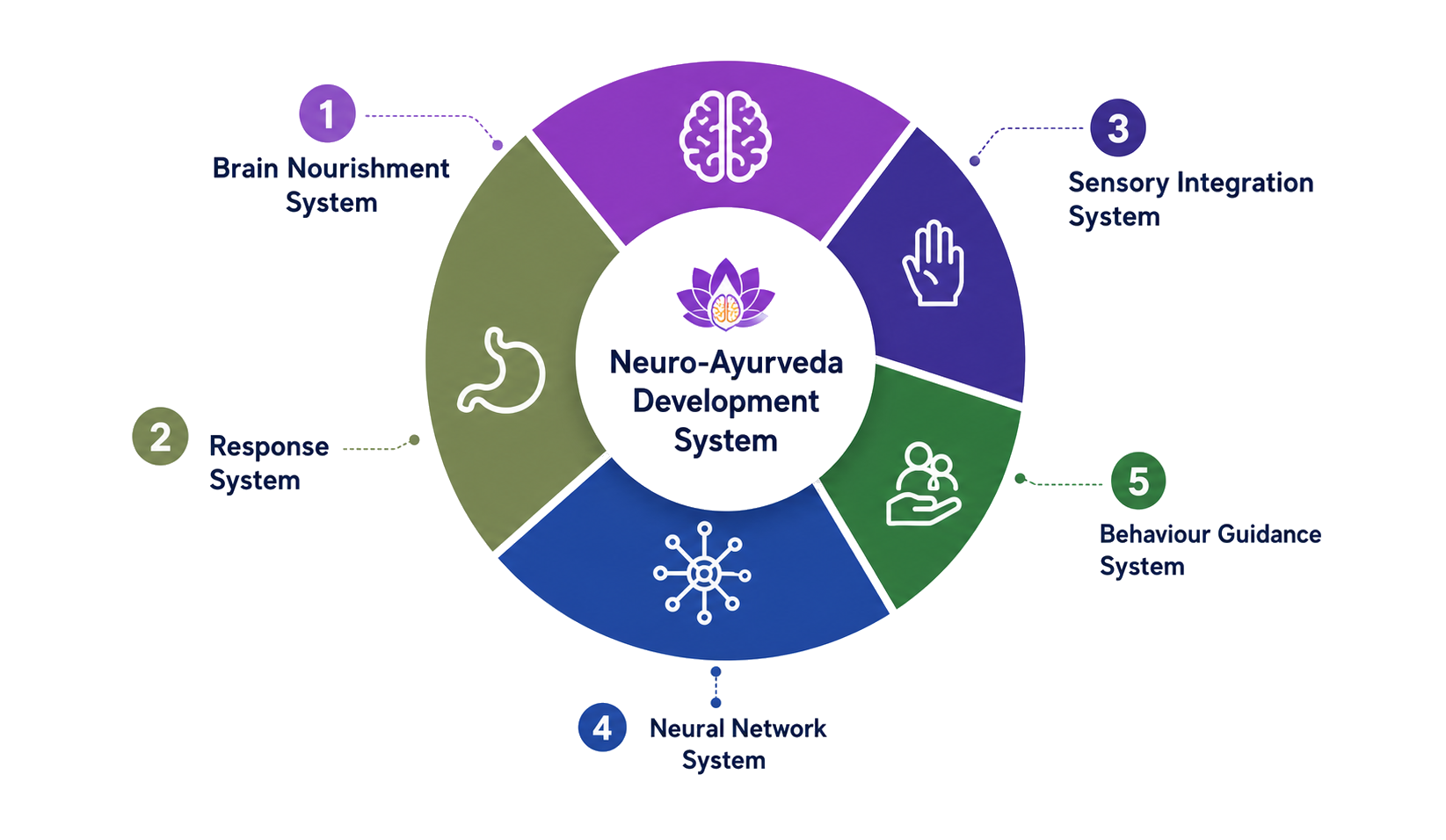
Developmental, attentional and behavioural issues are seen at Manovaidya through the lens of a Neuro-Ayurveda Development System developed by Dr. Ankush Garg.
The system was designed to help families to better understand the interrelated factors that could impact learning, attention, behaviour, emotional regulation and child development in general.
The Neuro-Ayurveda Development System sets out to process beyond the symptom and understand the child's needs in terms of five pillars of development.
Pillar 1: Brain Nourishment System
Brain development impacts on attention, learning, memory, communication and emotional regulation.
The Brain Nourishment System concentrates on understanding factors which can influence:
Attention
Learning readiness
Memory
Cognitive functioning
Emotional regulation
Academic participation
The objective is to contribute to building better foundations of development and learning.
Pillar 2: Gut Response System
Digestive wellbeing may influence overall functioning and daily comfort.
Many children experiencing developmental concerns may also experience:
Picky eating
Appetite concerns
Digestive discomfort
Food sensitivities
Irregular bowel habits
The Gut Response System focuses on understanding how digestive wellbeing may influence overall development and functioning.
Pillar 3: Neural Network System
The brain's development is a complex process that involves multiple connectivity.
The Neural Network System is geared toward learning about factors that could impact:
Learning readiness
Attention
Communication
Behaviour
Response patterns
Social engagement
This pillar assists families to gain a wider perspective about development functioning.
Pillar 4: Sensory Integration System
Children who have ADHD may have a difference with how they process sensory information which can affect behaviour, attention and emotional regulation.
The Sensory Integration System is about comprehending:
Sensory sensitivities
Sensory seeking behaviours
Environmental influences
Daily functioning challenges
Self-regulation abilities
Being aware of any sensory needs can help families to support their child's participation and comfort.
Pillar 5: Behaviour Guidance System
Behaviours can be a means of communication.
Behavioral symptoms in children with ADHD can be related to inattention, emotional control problems, frustration or the demands of the environment.
The Behaviour Guidance System will help a family to understand:
Behaviour patterns
Emotional responses
Triggers
Self-regulation challenges
Positive behaviour support strategies
The aim is to go beyond 'reacting to behaviour', and to consider the factors that shape behaviour.
How We Work at Manovaidya
Children are all individual and support at Manovaidya starts with the understanding of the child as a whole person, and not just a diagnosis.
We begin by obtaining a detailed assessment to gain an understanding of developmental history, communication skills, behaviours, learning needs, attention profile, sensory responses and family concerns. Guiding families, they're given personalized guidance and a developmental roadmap customized to their child's needs.
Manovaidya does not take a 'one size fits all' approach, but instead uses the Neuro-Ayurveda Development System to help families become more aware of the factors that may affect their communication, attention, behaviour, learning, emotional wellbeing, and overall development.
Support highlights assessment, parent guidance, developmental planning, tracking progress and ongoing family support to enable parents to move forward with more clarity, confidence and direction.
Every child is unique. This is why support at Manovaidya begins with a detailed assessment, developmental understanding and personalized guidance rather than a one-size-fits-all approach.
How We Support Children with ADHD
Children are not all the same, that is why support at Manovaidya is personalised.
All children are different with different strengths, interests, challenges and developmental needs.
Our approach focuses on:
Understanding the child as an individual
Identifying developmental strengths
Recognizing areas requiring support
Providing structured parent guidance
Supporting learning and attention development
Monitoring progress over time
Encouraging long-term growth and wellbeing
The emphasis is on supporting meaningful developmental progress, with a structured and family-centred approach, rather than simply short-term behavioural outcomes.
Many families connect with Manovaidya while searching for ADHD Treatment in India because they are looking for personalized guidance regarding attention, behaviour, learning and child development.
Parent Guidance & Family Support

Not only the child is affected by ADHD, but the whole family system is also.
Many parents experience:
Frustration
Confusion
School-related stress
Behavioural challenges at home
Concerns about the future
Emotional exhaustion
Parent guidance is seen as a vital developmental pathway at Manovaidya.
Families are supported in their understanding:
Attention challenges
Learning patterns
Emotional regulation needs
Daily support strategies
Long-term developmental planning
Where parents increase their understanding and confidence they are better able to support their child's learning, behaviour and wellbeing.
Our goal is to help families move from uncertainty and frustration toward clarity, confidence and meaningful action.
Why Families Choose Manovaidya
It can be difficult to determine which support system to choose when a child has ADHD.
There may be conflicting advice from parents on attention problems, hyperactivity, learning problems and behaviour issues. Others are encouraged to pay attention only to academics; others to only behaviour management. Many families over time are looking for a more systematic and comprehensive grasp of the needs of their child.
Our objective at Manovaidya is to make our families understand the situation at a glance.
We don't just consider each symptom in isolation, we consider multiple symptoms across the domains of attention, learning, behaviour, emotional regulation and development as a whole in a structured Neuro-Ayurveda Development System.
Families from Delhi, Noida, Greater Noida, Ghaziabad and Gurgaon and other areas of India communicate with Manovaidya for ADHD Assessment, Child Development Guidance and structured developmental support.
Personalized Developmental Understanding
All children are different. Assessment and guidance is individualized to the child's strengths, challenges and developmental needs.
Structured Neuro-Ayurveda Development System
The five-pillar framework assists families in recognizing the areas that could impact attention, learning, behavior, emotional control and other aspects of development.
Family-Centred Approach
Parents are not to be left to travel a journey alone. Advice will be targeted towards assisting families in gaining clarity and confidence in supporting their child.
Long-Term Development Focus
The focus is not just on immediate behaviour outcomes, but also on supporting meaningful development over time.
Personalized Guidance & Progress Tracking
Structured recommendations and support are provided for families to understand development and future plans.
Support Across Different Developmental Needs
This approach can work with children who are having difficulties with attention, learning, behaviour, emotional regulation, social interaction and executive functioning.
What makes families trust Manovaidya is that they are seeking ADHD Treatment support that is structured, tailored to their child's needs, and offers them a long-term developmental plan.
Frequently Asked Questions About ADHD
Attention Deficit Hyperactivity Disorder (ADHD) is a condition of neurodevelopment that has the potential to impact attention, focus, behaviour, emotional control and functioning. For children with ADHD, paying attention to tasks, listening to instructions, controlling impulses, and organizing daily activities can be challenging. Not all children with ADHD have the same symptoms, and symptoms may be different for each child. Children often have only attention problems, or they might be hyperactive, impulsive, or both. ADHD is viewed at Manovaidya in a broader developmental context beyond just paying attention to the symptoms. Attention, learning, behaviour, emotional wellbeing, and overall children's development are seen as a whole.
Book a Consultation
If you are looking for ADHD Treatment in India, ADHD Assessment, Attention Support, Learning Support or Child Development Guidance, you can schedule a consultation with Dr. Ankush Garg and the Manovaidya team.
Through a structured assessment and personalized guidance process, families can gain a clearer understanding of their child's developmental needs and explore appropriate next steps for long-term growth, learning and wellbeing.
Take the First Step
ADHD Assessment
Personalized Development Guidance
Parent Support & Family Guidance
Neuro-Ayurveda Development System
Structured Progress Planning
Book Your Consultation with Manovaidya Today
Manovaidya Clinic
Noida, Uttar Pradesh, India
Book a Consultation
Take the First Step Today
If you are searching for ADHD support, Assessment, learning support or guidance for child development in India, you can schedule an appointment with Dr. Ankush Garg and Manovaidya Team.
Families can gain insight into their child's needs, and the best support for learning, growth and well-being, through an easy assessment and personalized guidance.
- CBT for ADHD
- Personalized Development Plan
- Parent Coaching & Family Support
- Neuro-Ayurveda Development System
- Structured Growth Strategy
Manovaidya Clinic
Noida, Uttar Pradesh, India