-CrYNDrPl.png)
Learning Assessment, Attention Support & Child Development Guidance
Learning Assessment, Attention Support & Child Development Guidance
Learning and Attention Support Services in India
Summary points
Summary points
- Introduction
- Learning vs Attention Difficulties
- Signs of Learning Difficulties
- Understanding Learning Beyond Academics
- Learning & Attention Assessment
- Growth and Development History
- Learning Challenges and Processing Skills
- Treatment Options for Learning Difficulties
- Neuro-Ayurveda Development System
- Supporting Learning & Attention Needs
- Parent and Family Support
- Our Approach at Manovaidya
- Why Families Choose Manovaidya
- About Dr. Ankush Garg
- Frequently Asked Questions
- Schedule a Consultation
Learning and Attention Support Services in India
Learning assessment, attention support and child development guidance at Manovaidya.
Schedule ConsultationIntroduction
All children have different learning styles. Children may quickly learn new concepts, follow directions and adapt to the learning requirements of the school while others may have trouble focusing, paying attention, remembering, learning the pace of learning or may struggle academically. [,]
When a child has difficulty paying attention, forgets things quickly, can't get it done, falls behind at school or requires repeated instructions to comprehend ideas, many parents become anxious. Such challenges may impact the child's self-esteem, academic performance, and emotional well-being, as well as their overall development. [,,]
At Manovaidya we provide a holistic child developmental assessment process, not just as an academic problem, to understand learning and attention difficulties. Attention, communication, emotional well being, behaviours, sensory integration and developmental readiness are closely tied to learning. [,,,,]
Parents who want assistance with their children's learning problems, attention problems, evaluations, or academic growth usually require clear understanding, organized assistance and direction in the long-term development of their child. [,]
What are Learning & Attention Difficulties?
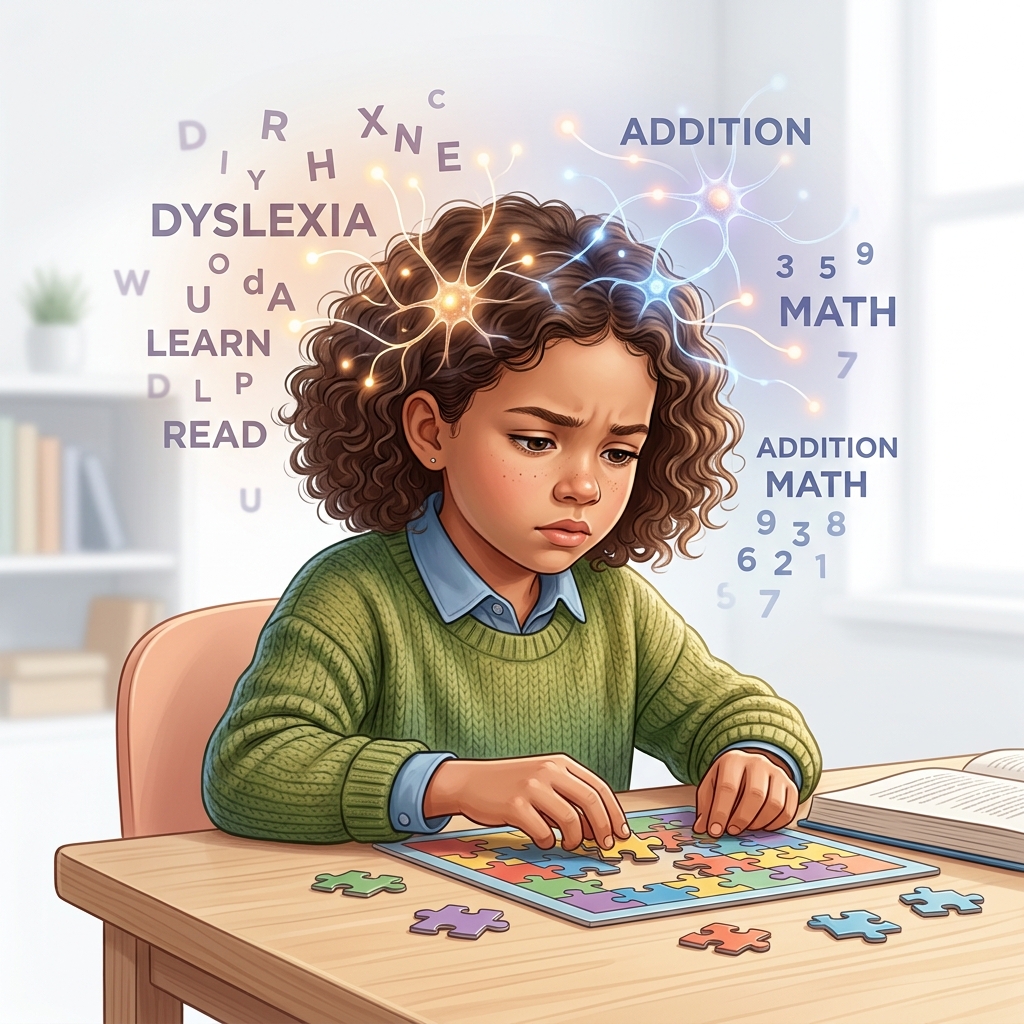
Learning and attention difficulties are academic problems that may make it more difficult for a child to pay attention, to comprehend information, to remember information, to follow directions, to do schoolwork. [,,]
The problems faced by each child are unique.
Some children may struggle to focus and attend or may struggle to learn, understand, remember or do things. [,]
To understand these challenges, it is important to look beyond school achievement and take into account the child’s overall development. [,,]
What is the difference between learning difficulties and attention difficulties?
Some children may have difficulties to understand and to learn new competence, others may have difficulties to maintain attention and focus. Sometimes these challenges can occur simultaneously and sometimes they are not the same. Families will have a better idea of what their child needs and will be better informed about the help they can provide to help their child grow and succeed. [,,]
What are the Common Signs of Learning & Attention Difficulties?
Some signs may be seen by parents [,]
What things are involved in Difficulty with focus?
Limited attention span
The child may struggle to focus on one activity for a sustained period of time. They can get bored very easily and lose interest.
Attention gets easily diverted
The child is easily distracted by small noises, movements or activities around them. This can interfere with learning and ability to carry out daily tasks.
Struggling to finish tasks
Child might begin something but struggle to finish it without cues or assistance. This may occur at home, and in school.
Tends to jump between tasks
The child can switch from one task to the next instead of finishing one activity. This can make learning and everyday activities more difficult. [,]
What components are present with learning difficulties?
Difficulty in processing new ideas
The child may require additional time to get information or concepts. Information will be easier to learn if it is broken down into steps.
Gradual learning process
There are children who are slower than others in learning. With regular practice and proper guidance, they can continue making progress.
Needs frequent repetition
The child might need to be told or given lessons several times before they understand. Repeating the subject and its activities can sometimes facilitate learning and confidence.
Academic challenges
It can make school work like reading, writing or doing assignments challenging. These challenges may impact students' academic outcomes. [,]
What memorizing difficulties does a child face?
Short-term memory challenges
Child might forget things previously learned or daily instructions. This can hinder the learning of new topics.
Trouble remembering directions
Child may have poor memory for or be unable to follow one or more-step directions. May require reminders to do things properly.
Reduced ability to retain concepts
The child may struggle to remember what he/she learned after. Improving memory through regular revision and practice. [,]
What academic concern does a child have regarding learning?
Struggles with assignments
The child might need more time for homework or class work. They might also require additional assistance to complete tasks properly.
Lack of organizing skills
Organizing school materials, books and/or daily tasks might be challenging. This can impact learning and classroom performance.
Limited participation in class activities
Child may be reluctant to respond to questions or participate in classroom conversations. They may not feel as confident as they could when taking part.
Decline in academic performance
Problems with learning can slowly impact performance at school and in general academic achievement. Early assistance to enhance learning outcomes.
Academic struggles
For some children, some subjects will be harder than others. It is important to know why these challenges are occurring in order to offer appropriate support.
Difficulty concentrating in studies
The child might struggle to concentrate with longer study sessions. This may impact learning, understanding and remembering information. [,,]
What are the Behaviour challenges a child gets During Learning?
Challenges with learning
Sometimes children lack confidence and are not keen to try new tasks due to learning difficulties. These challenges are unique to each child.
Procrastination and avoiding schoolwork
Child might postpone homework or decline challenging learning because they do not know how to do it. With some encouragement and support, this can be helped.
Lack of confidence in learning academic abilities
If the child has repeated learning difficulties it may lead to a lack of confidence in their own capabilities. The building of self-belief can be achieved over time through positive guidance.
Concerns regarding academic performance
When a child is unsuccessful in maintaining the pace of learning, he or she may become concerned about school performance. Help and knowledge can have a positive effect. [,]
How do you understand learning beyond academic achievement?
The myth of learning difficulties is that they are only due to intelligence. There are several areas of development that are important to learning and a child who is intelligent can still have difficulties in learning, attention, communication and behaviour. [,,]
Concentration problems in children
It can be hard for some children to concentrate when studying or taking part in activities during the day. May be easily distracted, which makes learning or doing tasks more difficult.
Communication and expressive skills
Communication skills are essential for children to follow instructions, to convey their ideas and to communicate with others. Learning and participation in the classroom may also be impacted by challenges in communication. []
Emotional health
The emotional health and wellbeing of children is linked to their learning and development. Stress, frustration, and anxiety can impact attention, confidence and academic outcomes. [,]
Behavioural tendencies
What a child does when learning can be used to gain useful information about the child's developmental needs. To plan a family or professional support appropriately, understanding behaviour can help.
Sensory functioning
Some children may be sensitive to sounds, touch, lights or movement. These sensory experiences will affect concentration, learning and participation in everyday activities. []
Readiness for learning
Children learn better when they are able to learn new things and skills when they are developmentally ready. The areas of readiness involve attention, communication, behaviour, emotional development and thinking skills. [,]
Social communication
Social communication supports children's friendship development, their awareness of social situations and their involvement in group games. Good social skills also have a positive impact on confidence and development. []
IQ is not enough to learn. A child might have good intelligence and be able to do so much, but still struggle with focus, memory, information processing, emotional regulation, or communication. [,]
Learning challenges at Manovaidya are not seen as a problem in just learning but also in overall development. By this way, families will be able to understand their child's strengths, challenges and developmental needs in full. [,]
What is the Learning & Attention Assessment at Manovaidya?
Each child has a unique learning profile. The emphasis is on Assessment for Understanding, not just Assessment of Understanding. [,]
The assessment process may consist of:
What does growth and development history contain?
Early childhood development
Knowledge of developmental milestones is important to determine the child's growth and learning over time. It also offers important information on the developmental trajectory of the child.
Learning characteristics
All children learn differently and at their own rate. These characteristics can be used to inform planning for individual support.
Educational concerns
Parents and teachers might see difficulties with school learning, attention, or in the classroom. These concerns can be used to inform additional assessment.
Parental insights
It is important to listen to what parents have to say about the child's behaviour, learning and development in the day to day life. They use their observations to develop a full picture of the child's needs. [,]
What challenges does the learner experience in understanding, processing, and applying new concepts?
Attention characteristics
Knowing a child's attention pattern allows for the identification of their ability to focus, engage and finish activities. This information is key in planning the appropriate learning support. [,]
Memorizing capabilities
Memory is of paramount importance in learning, comprehending and recalling information. Evaluation of memory provides feedback on a child's need for extra support. [,]
Interaction skills
Interaction skills support children in their ability to communicate, join in with others and relate to others. Learners are helped in their learning through good interaction, both inside and outside the class. []
Learning capacity
All children are unique in their capacity to comprehend and acquire new knowledge. Understanding a child's ability to learn enables educators to set realistic targets and provide personalized support. [,]
Learning approach and habits
Children learn in a variety of ways dependent on their strengths and experiences. These habits can be used to enhance the learning process and long-term achievement. [,]
Its purpose is to help families to better understand the skills and difficulties in learning and the supports required. This enables parents to make informed choices and confidently help their child to develop in all areas. [,]
What are the treatment options for learning difficulties in India?
In India, many families on the hunt for learning support seek solutions that can enable their children to learn and grow. The first step is to assess the child's individual development needs in a thorough manner. [,]
What are the Factors affecting learning challenges?
Concentration problem in children
Concentrating may result in problems in learning, remembering, and completing tasks. If they can't concentrate, it helps to find out why and the appropriate support. [,]
Interaction difficulties
A child who has difficulty with communication and interaction with others also may have learning challenges. Improved interaction skills can lead to better participation and confidence. []
Patterns and reactions to behavior
The behaviour of a child may be a key indicator of his or her learning and developmental needs. To be able to understand behaviour, enable better support strategies. [,]
Emotional health
Emotional wellbeing positively affects learning, attention and confidence. Assisting emotional health promotes children's involvement in daily activities. [,]
Developmental progress by age
All children progress at individual rates and development should always be considered on an age appropriate basis. Assessment on a regular basis can help identify strengths, and areas that need support. [,]
External factors
The child's learning and growth may be affected by family environment, school experiences, daily activities and social environment. Knowing these factors helps to guide accordingly. [,]
How does the Neuro-Ayurveda Development System work?
At Manovaidya, learning and attention support is based on the Neuro-Ayurveda Development System developed by Dr. Ankush Garg. This method integrates up to date knowledge of child development and Ayurvedic principles into a structured understanding of learning, behaviour, communication and growth. [,,,,]
The framework is built on five core pillars, which are interlinked:
Brain Nourishment System
The Brain Nourishment System is designed to explore brain development, thinking skills, learning, memory and attention. A healthy brain is the building block for improved learning, communication and child development. [,]
Gut Response System
The Gut Response System is a holistic system that targets overall health, digestion, wellbeing and developmental progress. The link between the gut and the brain has been shown to affect the behaviour, emotions and learning of many children. [,]
Neural Network System
The Neural Network System is designed to learn about how the brain receives, processes, stores, and utilizes information. An understanding of these processes is helpful to learning, memory, and developmental progress. [,]
Sensory Integration System
The Sensory Integration System can be used to determine children's response to sound, touch, movement, light and other sensory experiences. Knowledge about sensory processing is used to enhance attention, learning, behaviour and participation in everyday activities. []
Behaviour Guidance System
The Behaviour Guidance System can support families to understand the connection between behaviour and learning, attention, emotions and development. Such knowledge can help to guide children in their daily lives. [,]
These five pillars are used as a structured approach to understanding learning, attention, communication, behaviour and child development. The goal is to provide families with an understanding of their child's strengths and developmental needs, from a holistic perspective. [,,,,]
How We Support Children with Learning & Attention Difficulties?
Learning assessment
A comprehensive evaluation is conducted to understand your child's learning strengths, challenges and developmental needs in a detailed way. This can aid in determining the areas that require individualized assistance. [,]
Understanding attention
We evaluate your child's ability to concentrate, be attentive, and complete daily activities. Knowing the pattern of attention enables us to prepare for the best support for learning and development. [,]
Development planning
Each child has their own individual development plan, based on the results of their assessments and their individual needs. The plan is for long term learning, confidence and overall growth. [,]
Parental support
Parents are provided with practical advice to help them to understand their child's learning, behaviour and developmental needs. Working together helps create a supportive environment both at home and outside. [,]
School learning readiness
We know if your child is ready for school learning, based on their attention, communication, behaviour and developmental skills. This will assist in identifying supports for improved classroom participation. [,]
Communication growth skills
Your child's understanding, expression and communication skills are assessed. Communication skills during learning, confidence and social interaction are supported. []
Tracking progress
Follow-up helps us to be aware of your child's progress and changing developmental needs. This provides an opportunity for a timely change in the support plan if needed. [,]
Ongoing family support
Families are supported throughout their child's developmental journey. Ongoing support enables parents to feel confident and promotes ongoing progress. [,]
Part 6
How do we provide support to parents and families at Manovaidya?
There is a strong likelihood that the family will be involved as well as the child. Parents might ask themselves a lot of questions about their child, their behaviour and what they are learning about their child in the future. They may want guidance to help them to support their child with more confidence. [,,]
At Manovaidya, parents are guided to understand learning patterns and developmental factors to help children to build their confidence and develop over the years. This family-centred approach will provide support for both the child and parents on the developmental journey. [,]
How do we work at Manovaidya to help children with learning difficulties?
Learning Assessment
We start with a detailed assessment to know the learning profile, the strengths and developmental challenges of the child. This enables the key areas to be identified where there is a need for tailored support. [,]
Identifying learning difficulty patterns
The areas in which the child is having difficulties in learning, attention, memory, communication or behaviour are carefully identified. The patterns give a clue to structuring a support plan. [,]
Customized plan
All children have an individual development plan to support their needs for learning and development. This plan aims to foster long term learning, confidence and development. [,]
Ensuring that parents are well supported and guided
Parents are given hands on advice on what their child needs to learn and how. This allows families to offer the Children better support throughout the day and at home, during learning. [,]
Monitoring sustainable progress for long run
Follow-up ensures monitoring of the child's developmental progress and learning improvements over time. It also enables the support plan to be amended as necessary for improved long-term outcomes. [,]
The first step towards meaningful support is to have a clear understanding of how the child is developing, learning, communicating, behaving and what concerns are at home that influence the child's development. The full picture is needed to develop better and tailored support for development. [,,]
This way, families can get individualised advice and a development plan. Emphasis is on the child's strengths and on the child's developmental challenges. [,]
Using the Neuro-Ayurveda Development System, Manovaidya will assist parents in gaining understanding of their child's individual needs and the influences which are impacting learning, attention and overall development. It merges the modern understanding of development along with the classical ayurvedic approach towards holistic development of children. [,,,]
Why do Families choose Manovaidya for improving the learning needs of their child?
Structured Neuro-Ayurveda Development System Approach
Through our structured Neuro-Ayurveda Development System, we assist families to gain an understanding of the various factors that affect a child's learning, behaviour, communication and development. This will involve trying to view the child as a whole, rather than a child with just one problem. [,,,,]
Personal learning & growth analysis
All children are unique in their strengths, abilities and learning needs. These differences can be understood through detailed assessment and individual guidance for long-term development can be created. [,]
Child led and family supported model
We take a child-centred approach which recognises that all children develop at different rates and engages parents in the process. The involvement of families is important in supporting the learning and overall development of the child. [,,]
Supporting the learning skills, concentration and overall development
The developmental skills, behavioural, communication and attention factors and learning ability are all improved together. This increases children's confidence in their everyday learning and development. [,,]
Ongoing support and progress tracking
The developmental needs of children can change with time and follow-up is important. Monitoring is ongoing to gain insight into progress and amend the support plan as necessary. [,]
Personalized Growth Planning
All children are given an individual growth plan which is founded on their assessment results and developmental needs. The plan will support continuous improvement and progress over time. [,]
Empathetic and systematic guidance
We feel that each family should have empathy, support and clear direction along the way of their child's developmental process. The systematic approach facilitates parents to make informed decisions with a degree of confidence. [,,]
Delhi, Noida, Greater Noida, Ghaziabad, Gurgaon, Faridabad, NCR, and other parts of India's parents reach out to Manovaidya for compassionate care in Learning Difficulties, Attention Assessment and Child Development Guidance.
About Dr. Ankush Garg

Authorised & Clinically Reviewed
Dr Ankush GargFounder, Manovaidya | Ayurvedacharya | Creator of the Neuro-Ayurveda Development System
Clinical Focus: Autism, ADHD, Child Development and Mental Health
Neuro-Ayurveda Development System
Autism, ADHD, Child Development & Mental Health Specialist in India
Dr. Ankush Garg is the Founder of Manovaidya and the Inventor of Neuro-Ayurveda Development System. He is interested in understanding child development by integrating modern developmental science and Ayurvedic science, to offer structured and individualized care. [,,,,]
His primary practice areas include Autism Spectrum Disorder (ASD), ADHD, child development and speech and communication disorders, behavioural disorders, learning disabilities, mental wellbeing of teenagers, mental wellbeing of adults, emotional wellbeing of women and mental wellbeing of seniors. A full picture of development, behaviour, communication and emotional wellbeing is needed for these conditions. [,,,]
Through thoughtful learning assessment for children, personalized guidance and empathetic family support, he empowers families to understand developmental issues and take steps forward with confidence and reassurance. All children are supported individually based on their strengths and needs. [,,]
Frequently Asked Questions (FAQs)
What are learning and attention difficulties?
Learning and attention difficulties are difficulties in focusing, understanding, remembering and completing daily learning activities that may be present in a child. These difficulties may affect children's school achievement, confidence and development, but with appropriate understanding and support, children can still make progress. [,,]
What are the early signs of learning difficulties in children?
Early indicators can involve problems with understanding abstract concepts, requiring instructions to be repeated, poor memory, slow rate of learning, problems with reading or writing, and refusal of more difficult school work. It is important to be aware of the signs at an early age so that families can find the appropriate guidance and support. [,,]
What are the common signs of attention difficulties in children?
Children who have an attention problem may have trouble concentrating, paying attention, remembering directions, or difficulty finishing tasks. These problems can impact on learning, class participation, and life in general. [,]
What is the difference between a learning disability and ADHD?
A learning disability is primarily when a child has difficulties understanding, processing and using information while ADHD is primarily when a child has trouble paying attention, focusing, impulse behaviour and self-control. Both conditions may coexist but are distinct and need to be assessed correctly to meet the needs of the child. [,,]
Do learning disabilities affect intelligence?
NO – A child with learning disabilities is not necessarily less intelligent than another child. Children with learning difficulties do not necessarily have below-average intelligence; many learn like average or above-average children and require the proper support. [,]
Why does my child struggle to focus on studies?
Attention problems, learning challenges, emotions, communication problems, developmental delays, and environmental distractions are all potential causes of difficulty focusing. If you know the cause of the problem, you can better select the right support. [,,]
Why does my child forget things so quickly?
Attention problems, Challenges with learning, Stress, and Processing new information can cause children to forget information. Memory and attention go hand in hand – a knowledge of both can help determine the appropriate type of assistance. [,]
Can learning difficulties affect school performance?
Yes. Children might find it more difficult to comprehend lessons, complete tasks, understand things and engage in classroom activities because of learning difficulties. Early understanding and appropriate support has the potential to enhance learning outcomes and confidence. [,,]
Can communication difficulties affect learning?
Yes. Children use communication to understand instructions, to communicate their ideas, to ask questions, and to interact with teachers and other children. Communication skills are important in enhancing learning, confidence and social participation. []
Can learning abilities improve over time?
All children grow at their own rate. Many children will over time develop and improve in their learning skills, confidence and development with the right guidance, structured support and practice. [,]
How can parents support learning and attention development at home?
Here are some tips for parents to help their child: Establish a routine, provide clear directions, facilitate learning experiences, and celebrate progress. The home environment is important to a child's learning and development. [,]
What activities can help improve attention and learning skills?
Reading, storytelling, puzzles, memory games, creative play and problem-solving tasks can help support attention, thinking, communication and learning. These activities should always be age appropriate, of interest and developmental level to the child. [,,]
When should parents seek help for learning and attention difficulties?
It is important for parents to seek help if learning or attention problems are causing difficulty in school, in communicating with people, in confidence, in behaviour, or in everyday activities. Early assessment supports families to know their child's needs and plan the appropriate support. [,]
What is the Neuro-Ayurveda Development System?
Dr. Ankush Garg's Neuro-Ayurveda Development System is a structured method to gain insight into a child's learning, behaviour, communication and entire development. This is a synthesis of the modern developmental approach with the classical ayurvedic approach which gives a holistic perspective to the child development. [,,,,]
How does Manovaidya assess and support children with learning and attention difficulties??
The purpose of assessment at Manovaidya is to gain an understanding about the child's learning capabilities, attention, communication, behaviour, developmental history and family concerns. With this insight, parents are offered individual counseling and a developmental plan in the Neuro-Ayurveda Development System to guide their families into long-term growth and development. [,,,,]
Book a Consultation
Take the First Step Today
For any academic or developmental assistance, education difficulties, attention issues, or other learning concerns, visit Dr. Ankush Garg and the Manovaidya team for guidance. The first step is to have a detailed assessment of your child's strengths, challenges and developmental needs. [,]
Families receive a detailed multi faceted learning assessment and tailored guidance on their child's learning and developmental profile and next steps to maximize future learning. To ensure that every child is confident, learns to their full potential and achieves the development they need, supported at the right time and place. [,,]
- Learning Assessment
- Attention Support
- Parent & Family Support
- Neuro-Ayurveda Development System
- Personalized Growth Planning
Manovaidya Clinic
Noida, Uttar Pradesh, India