
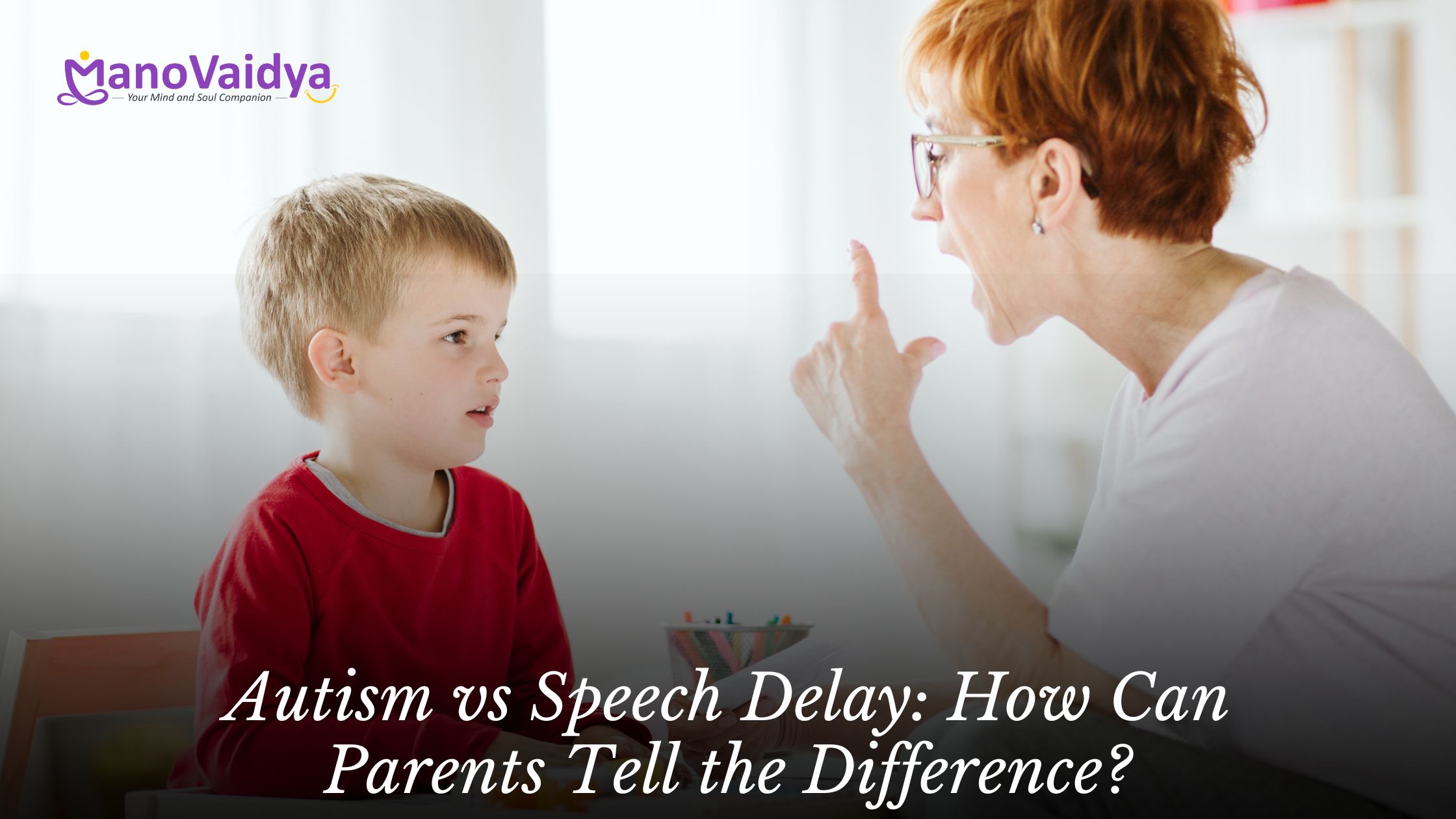
Is your child speaking fewer words than other children of the same age, or are you noticing differences in eye contact, gestures, play, or social interaction? Early signs of autism in children can sometimes be confused with a simple speech delay because both may involve delayed communication.
But speech delay and autism are not the same thing. A child may have delayed speech and still have typical social communication, while an autistic child may have differences in social interaction, communication, play, or repetitive behaviours along with delayed language. Understanding the broader developmental picture can help parents decide when a professional evaluation or consultation may be appropriate.
About Dr. Ankush Garg

Dr. Ankush Garg is an Autism, ADHD, Child Development and Mental Health Specialist in India, Founder of Manovaidya and Creator of the Neuro-Ayurveda Development System.
His work focuses on developmental, behavioural, and mental wellness concerns through a structured approach that considers the individual child's needs, behaviour, communication, attention, and everyday functioning.
What Is Speech Delay?
Speech delay generally refers to a child developing spoken speech skills later than expected for their age. The concern may involve the sounds a child produces, the number of words they use, or how clearly they speak.
However, speech and language are not exactly the same.
Speech involves producing sounds and words, while language involves understanding and communicating meaning through words, gestures, signs, or other forms of communication.
A child may understand what parents say but have difficulty expressing themselves. Another child may have difficulty both understanding and expressing language.
Hearing difficulties, speech disorders, developmental language disorder, and other developmental factors can contribute to communication difficulties. A hearing assessment may also be considered because hearing problems can affect speech and language development.
What Makes Autism Different From a Speech Delay?
One of the biggest differences is that Autism involves more than delayed talking.
A child with a speech or language delay may still:
Make eye contact naturally
Point to show something interesting
Use gestures to communicate
Try to share experiences with parents
Enjoy interactive games
Respond to people around them
Show interest in social interaction
Use facial expressions and body language to communicate
A child with autism may have differences in social communication and interaction, along with restricted or repetitive behaviours or interests. These differences can appear in different ways and may vary from one child to another.
This is why simply counting the number of words a child speaks cannot determine whether the child is autistic.
Early Signs Parents May Notice
Parents are often the first people to notice that something feels different about their child's development.
Possible concerns may include:
Limited response when their name is called
Less use of gestures such as pointing or waving
Limited back-and-forth interaction
Difficulty sharing attention with another person
Repetitive movements or play patterns
Strong reactions to particular sounds, textures, or changes
Unusual interest in specific objects or activities
Difficulty with pretend or interactive play
None of these signs alone confirms autism. Development needs to be considered as a whole, including how the child plays, communicates, learns, behaves, and interacts with other people.
Autism Signs in Toddlers: What Should Parents Observe?
The Autism signs in toddlers may be subtle, which is why parents sometimes initially think, “My child is just a late talker.”
For example, two toddlers may both use very few words. One may compensate by pointing, making eye contact, bringing objects to parents, and trying to communicate through gestures. Another may show less interest in sharing attention, have limited gestures, repeat certain actions, or respond differently to social interaction.
These differences do not mean that one child definitely has autism. They simply show why communication should be evaluated beyond spoken vocabulary.
NIDCD notes that early communication includes skills such as gestures, imitation, babbling, and other pre-language behaviours, not only spoken words.
What Are the Autism Symptoms in Toddlers?
When parents search for Autism symptoms in toddlers, they often focus mainly on speech. However, autism can involve several developmental areas.
Parents may notice differences in:
Communication: The child may use fewer gestures or have difficulty with back-and-forth communication.
Social interaction: The child may seem less interested in sharing experiences or interacting with others.
Play: Play may be repetitive or focused strongly on particular objects or activities.
Sensory responses: Certain sounds, textures, movements, lights, or everyday sensations may produce unusually strong reactions.
Behaviour and routines: Some children may become distressed by changes or show repetitive behaviours.
These patterns need to be considered according to the child's age and developmental stage rather than using one behaviour as a diagnosis.
What Are the Signs of Autism in a 2-Year-Old?
The Signs of autism in 2 year old children can include differences in social communication, gestures, shared attention, play, response to others, and repetitive behaviours.
At around two years, parents can also compare their child's development with age-appropriate developmental milestones. CDC guidance emphasizes monitoring how children play, learn, speak, act, and move, rather than focusing on one milestone alone.
If a two-year-old has limited speech but actively points, gestures, shares interests, responds socially, and understands communication, a speech or language evaluation may be particularly relevant. If communication difficulties occur alongside broader social or behavioural differences, developmental screening may also be appropriate.
What About Signs of Autism in a 3-Year-Old?
The Signs of autism in 3 year old children may become easier to notice as social and communication expectations increase.
For example, parents may notice that the child:
Has difficulty participating in back-and-forth conversations
Rarely shares interests with others
Finds changes in routine particularly difficult
Uses repetitive language or behaviours
Has difficulty with interactive or pretend play
Shows unusual sensory responses
Again, these observations do not establish a diagnosis. A child's complete developmental history and current functioning need to be considered.
How to Identify Autism in Children?
Parents often ask How to identify autism in children when speech delay is the first concern they notice.
The answer is to look beyond speech.

Ask yourself:
Does my child communicate without words?
Do they point, gesture, bring objects, or use facial expressions?
Does my child share attention?
Do they look at something and then look toward you as if to share the experience?
Does my child respond socially?
Do they show interest in people, imitate others, or participate in simple interactive games?
How does my child play?
Is their play varied and interactive, or is it strongly repetitive?
Are there repetitive behaviours or unusual sensory responses?
These questions can help parents identify areas that may need further evaluation, but they should not be used as a home diagnosis. Autism assessment generally involves developmental history and professional observation, and no single screening tool should be used alone to diagnose autism.
How to Know If Your Child Has Autism?
If you are wondering How to know if child has autism, start by looking at the complete pattern rather than asking whether your child talks enough.
A professional assessment may consider:
Speech and language development
Understanding of language
Gestures and non-verbal communication
Social interaction
Play skills
Repetitive behaviours
Sensory responses
Developmental history
Functioning at home and other settings
If speech is delayed, a hearing assessment and speech-language evaluation may also be appropriate. NIDCD recommends discussing concerns with a child's doctor and notes that speech-language professionals can evaluate communication and recommend appropriate support.
A Personalized Approach to Child Development
At Manovaidya, the child's developmental profile can be considered more broadly rather than focusing only on delayed speech.

The Neuro-Ayurveda Development System includes five interconnected areas:
Brain Nourishment System
Response System
Sensory Integration System
Neural Network System
Behaviour Guidance System
The purpose of this framework is to consider different aspects of a child's development and individual needs. It should not be considered a diagnostic test or a replacement for established developmental assessment.
For families in India looking for a Child Development Specialist, understanding the child's complete developmental pattern can help determine what type of professional support may be appropriate.
Why Early Evaluation Can Help
Parents sometimes wait because they hope their child will “start talking soon.” While children develop at different rates, persistent developmental concerns are worth discussing rather than simply waiting without guidance.
CDC recommends talking with a healthcare professional when a child is not meeting developmental milestones or when parents have concerns about development. Early identification can help families access appropriate evaluation and support sooner.
The goal of an evaluation is not to label a child. It is to understand why communication or social development may be different and what support could help.
Final Thoughts
Speech delay and autism can look similar at first, especially when a child's spoken language is limited. But the important difference is that autism can involve broader differences in social communication, interaction, play, behaviour, and sensory experiences.
If your child is not speaking as expected, look at the whole picture: How do they communicate? How do they interact? How do they play? How do they respond to people and their environment?
Understanding these areas can help parents decide whether a speech-language evaluation, developmental screening, or a more detailed consultation may be appropriate.
Need Guidance for Your Child?
If you are concerned about your child's speech, communication, social interaction, behaviour, or overall development, Manovaidya can help parents understand the child's individual developmental needs and the next appropriate step through personalized guidance.
Call: +91-7823838638
Email: manovaidya2@gmail.com
References
CDC – Signs and Symptoms of Autism Spectrum Disorder
https://www.cdc.gov/autism/signs-symptoms/CDC – Screening for Autism Spectrum Disorder
https://www.cdc.gov/autism/diagnosis/NIDCD – Speech and Language Developmental Milestones
https://www.nidcd.nih.gov/health/speech-and-languageNCCIH – Autism and Complementary Health Approaches
https://www.nccih.nih.gov/health/autismNCCIH – Complementary Health Approaches for Autism: What the Science Says
https://www.nccih.nih.gov/health/providers/digest/autism-spectrum-disorder-and-complementary-health-approaches-scienceNCCIH – Children and the Use of Complementary Health Approaches
https://www.nccih.nih.gov/health/children-and-the-use-of-complementary-health-approaches