
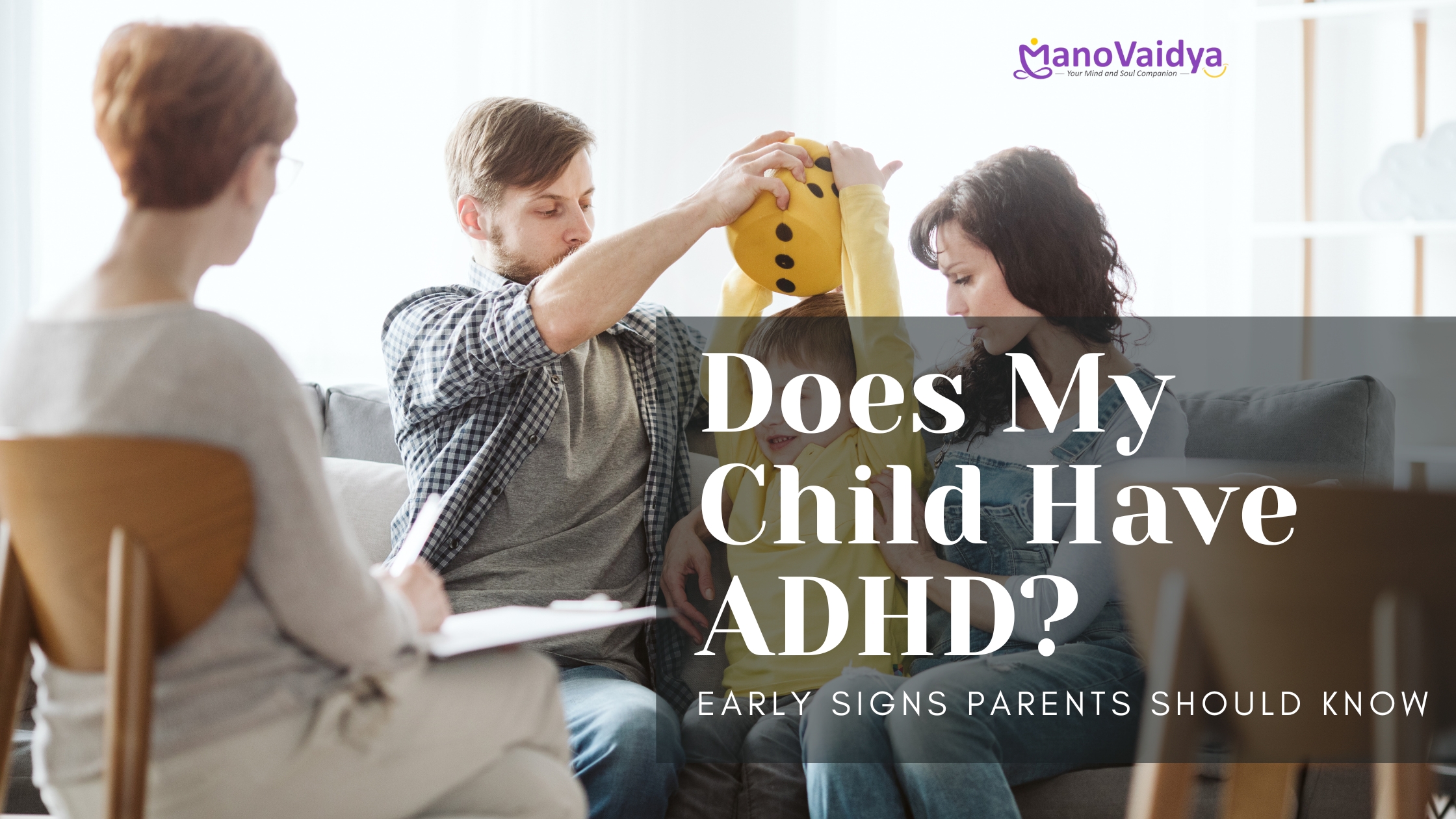
Does your child find it difficult to sit in one place? Do they start their homework but lose focus within a few minutes? Do you have to repeat the same instructions several times?
Maybe your child frequently loses pencils, books, or other belongings, interrupts conversations, or acts before thinking about what might happen next.
When parents notice these behaviours, a common question comes up: How do I know if my child has ADHD?
Being active, distracted, or occasionally forgetful does not automatically mean a child has ADHD. What matters is the overall pattern—how often these behaviours happen, how long they continue, where they occur, and whether they interfere with school, relationships, family life, or everyday activities.
Understanding the Early signs of ADHD in children can help parents recognise when a child's behaviour may need closer attention and when professional assessment may be appropriate.
What Is ADHD?
ADHD stands for Attention-Deficit/Hyperactivity Disorder. It is a neurodevelopmental disorder associated with persistent patterns of inattention, hyperactivity, and/or impulsivity that can affect everyday functioning.
These difficulties are generally understood in three broad areas:
Inattention – difficulty maintaining attention, organising tasks, remembering instructions, or completing activities
Hyperactivity – excessive movement or restlessness compared with what is expected for the child's age and situation
Impulsivity – acting or responding quickly without adequately considering the situation or waiting for a turn
Not every child experiences all three areas in the same way. Some children mainly struggle with attention, while others show more hyperactive or impulsive behaviours. Some experience a combination.
ADHD is not simply another word for being naughty, lazy, or poorly disciplined. Understanding the complete pattern is important when considering possible ADHD symptoms in children.
About Dr. Ankush Garg

Dr. Ankush Garg is an Autism, ADHD, Child Development and Mental Health Specialist in India, Founder of Manovaidya and Creator of the Neuro-Ayurveda Development System.
His work focuses on developmental, behavioural, and mental wellness concerns through a structured approach that considers the individual child's needs, behaviour, communication, attention, and everyday functioning.
As a Dr Ankush Garg ADHD Specialist, the focus is on understanding the child's overall developmental and behavioural pattern rather than identifying ADHD from one isolated behaviour.
Not Every Active Child Has ADHD
Children are naturally energetic. Running, asking questions, becoming distracted during homework, or occasionally not listening can all occur during normal childhood development.
The question becomes more important when these behaviours are persistent, occur more often or intensely than expected for the child's developmental level, appear in different situations, and begin affecting schoolwork, friendships, family relationships, or daily routines.
For example, a child who becomes restless only after several hours of school may simply be tired. Another child who consistently struggles to remain focused during age-appropriate activities at both home and school may need a closer evaluation.
So rather than asking only, Is my child very active? parents can look at the wider pattern of ADHD symptoms in children.
1. Attention Frequently Drifts Away
One of the common difficulties associated with ADHD is maintaining attention on a task.
A child may sit down to complete homework but become distracted by a sound, object, conversation, or activity nearby. They may read a question but miss important details, make careless mistakes, or move from one activity to another without finishing the first.
Parents may also feel that their child does not listen when spoken to, even though the child may have understood the instruction.
However, the important question is not simply how long a child can concentrate. Children naturally focus for different lengths of time depending on age, interest, tiredness, and the difficulty of the activity.
Persistent attention difficulties across appropriate situations can be among the Early signs of ADHD in children.
2. Difficulty Following Instructions and Completing Tasks
Imagine telling your child:
Put your bag away, change your uniform, and wash your hands.
The child may put the bag away but forget the other two instructions.
They may start their homework but leave it incomplete, move to another activity, and later forget what they were supposed to finish. Parents may also notice school projects remaining unfinished or difficulty organising everyday activities.
However, not every difficulty following instructions means ADHD. A child may struggle because the instruction was too long, they did not understand it, they were distracted, or they have another learning or communication difficulty.
When problems with organisation, instructions, task completion, and time management occur repeatedly, they may be relevant when considering How to identify ADHD in children.
3. Frequently Forgetting or Losing Things
Does your child often lose pencils, erasers, water bottles, books, toys, or school materials?
Do they finish their homework but forget to take it to school?
Occasional forgetfulness is common in childhood. The concern becomes greater when a child regularly loses things needed for school or daily activities and the pattern begins affecting responsibilities.
A child may also forget instructions soon after hearing them or repeatedly need reminders for everyday tasks.
When frequent forgetfulness occurs together with other persistent attention difficulties, it can be one of the Early signs of ADHD in children.
4. Excessive Activity and Restlessness
Some children find it difficult to remain seated when the situation requires it.
They may:
Constantly move their hands or feet
Fidget while sitting
Leave their seat when remaining seated is expected
Run or climb in inappropriate situations
Make excessive noise during quiet activities
Find it difficult to participate quietly
Seem to be constantly “on the go”
Young children are naturally energetic, so running around or being playful does not automatically indicate ADHD.
The more useful question is whether the activity level is significantly different from what is expected for the child's age and situation and whether it affects learning, safety, or social interactions.
These patterns can sometimes be noticed at school, making them relevant when parents are looking at signs of ADHD in school children.
5. Impulsivity: Reacting Without Thinking
Impulsivity involves responding or acting quickly without adequately considering the situation.
A child may answer before a question is completed, interrupt conversations, struggle to wait for their turn, or suddenly take something from another child.
They may also move quickly into situations without considering possible consequences, such as during play or while crossing a road.
This does not necessarily mean the child is intentionally trying to behave badly. For some children, stopping, thinking, and controlling an immediate response can be difficult.
When impulsive behaviour repeatedly affects classroom behaviour, friendships, safety, or family routines, it can form part of the broader pattern of ADHD symptoms in children.
6. Difficulty Managing Frustration and Emotions
Some children become frustrated quickly when a task feels difficult or when they have to wait.
They may become upset after losing a game, give up quickly when something does not work, or have strong reactions to everyday situations.
However, emotional outbursts alone do not confirm ADHD.
Similar behaviours can occur with anxiety, sleep difficulties, learning problems, autism, family stress, or other developmental and emotional concerns. This is why parents should avoid deciding that a child has ADHD based only on anger or emotional reactions.
Looking at the complete developmental and behavioural pattern is important when considering how to know if your child has ADHD.
7. Difficulties Appearing in More Than One Setting
This is an important part of understanding ADHD.
Suppose a child becomes restless only during homework at home, but their teacher reports that they pay attention, follow instructions, and complete classroom activities appropriately.
In that situation, ADHD may not be the only possible explanation.
Homework may be too difficult, the child may be tired, the environment may be distracting, or there may be a specific learning difficulty.
ADHD assessment therefore considers behaviour across different settings, such as home, school, and social situations. Information from parents, teachers, and other caregivers can help professionals understand whether the pattern is consistent.
This is particularly useful when parents are trying to understand signs of ADHD in school children.
What Are the Signs of ADHD in School Children?
School can make certain attention and behaviour patterns easier to notice because children are expected to follow instructions, complete tasks, remain engaged, organise materials, and interact with classmates.
Possible signs of ADHD in school children may include:
Frequently forgetting classroom instructions
Leaving assignments unfinished
Losing pencils, books, or other school materials
Making repeated careless mistakes
Difficulty waiting for a turn
Interrupting teachers or classmates
Frequently getting out of their seat
Struggling to organise schoolwork
Being easily distracted during classroom activities
However, these signs should not be treated as proof of ADHD. A teacher may notice a pattern that parents do not see at home, while parents may notice difficulties that are less visible at school.
Looking at information from more than one environment can provide a more complete picture of the child's functioning.

ADHD Does Not Look the Same in Every Child
ADHD symptoms can present differently from one child to another.
Predominantly Inattentive Presentation
A child may frequently lose focus, forget instructions, make careless mistakes, have difficulty organising tasks, or leave activities unfinished without appearing particularly hyperactive.
Predominantly Hyperactive-Impulsive Presentation
A child may appear very restless, talk excessively, interrupt others, struggle to wait for their turn, or frequently act before thinking.
Combined Presentation
A child may experience significant difficulties related to both inattention and hyperactive-impulsive behaviours.
This is why a child does not have to look extremely hyperactive for ADHD to be considered. The overall symptom pattern and its impact on daily functioning matter.
How to Identify ADHD in Children?
Parents often search for how to identify ADHD in children after noticing repeated attention or behaviour difficulties. However, ADHD cannot be identified reliably from one or two behaviours or from an online checklist alone.
A professional evaluation considers the child's developmental history, current symptoms, functioning, and behaviour in different settings.
For a clinical diagnosis, symptoms need to meet established diagnostic criteria, including persistence over time, presence in more than one setting, and clear impact on functioning. Several symptoms should have been present before age 12, and other possible explanations should also be considered.
There is no single blood test, brain scan, or questionnaire that independently confirms ADHD. Other concerns, including sleep problems, anxiety, depression, learning difficulties, and some medical or developmental issues, can produce symptoms that may look similar.
When Should Parents Consider an ADHD Assessment?
Parents may consider professional assessment when attention, hyperactivity, or impulsivity repeatedly begins affecting a child's everyday functioning.
For example:
Teachers regularly report attention or behaviour concerns
Schoolwork remains incomplete despite adequate understanding
Careless mistakes happen repeatedly
Instructions are difficult to follow at home and school
Impulsivity creates safety concerns
Friendships are being affected
Daily routines regularly lead to conflict
The child struggles to organise age-appropriate activities
The purpose of an assessment is not simply to attach a label. It is to understand why the difficulty is happening, whether ADHD may be involved, and whether another developmental, emotional, learning, or environmental factor could better explain the behaviour.
Understanding these factors is an important part of how to know if your child has ADHD rather than relying on assumptions.
Understanding the Child Before Deciding the Next Step
If parents are unsure whether their child's difficulties are related to ADHD, learning concerns, behaviour, or another developmental issue, a detailed consultation can help provide clarity.
At Manovaidya, attention, understanding, ability to follow instructions, impulsivity, behaviour, learning patterns, sleep, sensory concerns, and functioning at home and school can be considered as part of the child's overall developmental picture.
Any ADHD therapy for children should be considered according to the child's individual needs and professional assessment rather than assuming that every active or distracted child requires the same approach.
Similarly, discussions around ADHD treatment for children should begin with an appropriate understanding of symptoms, functioning, developmental history, and any coexisting concerns. Evidence-based clinical guidelines recommend a comprehensive evaluation and an individualized management approach.
A Personalized Approach to Child Development

Children can show similar behaviours for very different reasons. One child may struggle mainly with attention, another with learning, and another with emotional regulation or sensory experiences.
This is why understanding the child's strengths and difficulties together can be more useful than focusing on one symptom.
At Manovaidya, the Neuro-Ayurveda Development System provides a structured framework that considers different aspects of child development through:
Brain Nourishment System
Response System
Sensory Integration System
Neural Network System
Behaviour Guidance System
These components are presented as part of Manovaidya's individualized developmental approach and should not be interpreted as independent diagnostic criteria for ADHD.
Final Thoughts
If your child is frequently distracted, restless, forgetful, impulsive, or struggling to complete everyday tasks, it is understandable to wonder whether ADHD could be involved.
But remember three important points:
First: Not every active or distracted child has ADHD.
Second: ADHD is not only about hyperactivity. Attention difficulties, impulsivity, organisation, and functioning across different situations are also important.
Third: ADHD is not diagnosed simply by matching a child with a list of symptoms. Duration, developmental level, different settings, and the effect on daily life also matter.
Understanding the early signs of ADHD in children can help parents recognise when closer attention or professional guidance may be appropriate.
Instead of repeatedly calling a child “naughty,” “lazy,” or someone who “does not listen,” the more useful first step is to understand what the child may actually be struggling with.
Need Guidance?
If you have concerns about your child's attention, activity level, impulsivity, school performance, or overall development, you can contact the Manovaidya team for further guidance.
Call: +91-7823838638
Email: manovaidya2@gmail.com
References
Centers for Disease Control and Prevention (CDC) – Symptoms of ADHD
https://www.cdc.gov/adhd/signs-symptoms/index.htmlCenters for Disease Control and Prevention (CDC) – Diagnosing ADHD
https://www.cdc.gov/adhd/diagnosis/index.htmlCenters for Disease Control and Prevention (CDC) – Clinical Care of ADHD in Children
https://www.cdc.gov/adhd/hcp/clinical-care/index.htmlAmerican Academy of Pediatrics (AAP) – Clinical Practice Guideline for the Diagnosis, Evaluation, and Treatment of ADHD in Children and Adolescents
https://publications.aap.org/pediatrics/article/144/4/e20192528/81590/Clinical-Practice-Guideline-for-the-DiagnosisNational Institute of Mental Health (NIMH) – Attention-Deficit/Hyperactivity Disorder
https://www.nimh.nih.gov/health/publications/attention-deficit-hyperactivity-disorder-what-you-need-to-know