
Child Development Care & Developmental Treatment for Children in India
Child Development Care & Developmental Treatment for Children in India
Supporting Healthy Brain Development, Learning, Behaviour & Growth Through Every Stage of Childhood
Last Updated: [20-07-2026]

Child Development Care & Developmental Treatment for Children in India
Key Takeaways
- Understanding Child Development & Developmental Milestones
- Importance of Early Development & Identification
- Brain, Cognitive, Speech & Language Development
- Social, Emotional & Behavioural Development
- Autism, ADHD & Developmental Delays
- Learning, Attention & Executive Function Challenges
- Sensory Processing & Motor Development
- Signs Parents Should Not Ignore
- Comprehensive Child Development Assessment
- Neuro-Ayurveda Development System
- Personalised Developmental Support & Guidance
- Parent Education & Family Involvement
- Long-Term Development Monitoring & Follow-Up
- FAQs About Child Development Care
Want more content like this?
Join our Child Development, Autism and ADHD newsletter for more care tips from our experts.
Your privacy is important to us.
Introduction
Communication
Learning
Behaviour

All children develop at different rates. Some children develop their age-appropriate skills spontaneously, while others might require extra time and/or assistance in a variety of areas, including communication, learning, behaviour, attention, movement or social interaction. These differences can be understood at an early stage and can be considered by parents to help their child in general development.
Development of children is not only physical. It reflects how a child thinks, learns, communicates, behaves, moves and relates to the world around them. These various stages of development are interrelated and affect a child's confidence, independence and quality of life.
Many parents start to notice that their children have delayed speech, trouble holding their attention, behaviour problems, poor eye contact, learning problems, emotional outbursts or delayed developmental milestones. There are some normal variations, but if they are continuing then, developmental concerns are not to be overlooked.
Early identification helps families to know and understand their child's strengths and where there might be a need for extra help. Each child is unique and early guidance can offer more opportunities to develop children's communication, learning and everyday skills.
At Manovaidya, we know that there are many complex factors that affect child development such as brain development, nutrition, gut health, sleep, sensory processing, behaviour, emotional wellbeing and the child's environment. We do not make judgements about children based on one symptom or diagnosis, but rather, we strive to gain a full developmental picture of each child.
Under the guidance of Dr. Ankush Garg, Autism, ADHD, Child Development & Mental Health Specialist in India, Manovaidya provides children with a structured five-pillar approach known as Neuro-Ayurveda Development System to make parents aware of the developmental needs of their child through detailed assessment, customized directions and holistic developmental assistance.
At Manovaidya, Child Development Care Focuses On:
Child Development Assessment
Developmental Delays
Autism Spectrum Treatment
ADHD Treatment
Speech & Language Development
Learning & Academic Challenges
Behavioural Development
Emotional Development
Social Skills Development
Sensory Processing Support
Motor Development
Parent Guidance & Family Support
Understanding Child Development
Child development is a process that starts before birth and extends through childhood and adolescence. Along the way children become increasingly physically capable, communicative, emotionally regulated, thinking and socially related and independent.
Developmental milestones are a general guideline for the age at which many children are able to meet various developmental abilities; however, all children will have different developmental progressions. Small differences will occur. However, if delays are significant or persistent, it may be useful for a child to be further assessed and supported.
Healthy child development involves several interconnected domains:
Brain and cognitive development
Language and speech skills
Social communication
Emotional regulation
Behavioural development
Fine and Gross motor skills
Sensory processing
Learning and attention
Daily living skills
Improvements in one field can impact upon improvements in another. For instance, difficulties with communication can impact social relationships, sensory processing differences can impact behaviour, attention and/or participation in learning activities.
Many parents looking for Child Development Assessment, Child Development Delay Support, Autism Treatment, Speech Delay Guidance, ADHD Treatment and Child Development Care in India are looking for answers and understanding as to why their child is developing differently. The early identification of difficulties is a key initial step in giving the right guidance and support.
Why Early Child Development Matters
The early years of life are a period of rapid brain development. Children learn during this time, through experiences, relationships, play, communication and interaction with their environment.
Supporting development in these early years can facilitate children to reinforce essential life skills including:
Communication
Learning
Emotional regulation
Social interaction
Problem-solving
Attention
Independence
Behavioural flexibility
Early identification does not equate to labelling a child. Rather, it offers a chance to gain insight into the child's learning, communication and world experiences.
Parents can identify developmental issues early on and apply the right direction and guidance, and establish environments that promote learning and development.
Every Child Develops Across Multiple Areas
Child development is so more than just making it to milestones. All areas of development impact on children's learning, communication and interaction with others.
Brain & Cognitive Development
Facilitates thinking, memory, attention, problem solving, learning.
Speech & Language Development
Enables the language to be understood and ideas and information to be communicated.
Emotional Development
Acknowledges, expresses and regulates emotions in an appropriate manner with children.
Encourages friendships, co-operation, sharing, empathy and social communication.
Motor Development
Covers gross motor skills (e.g. running, jumping, balancing) and fine motor skills (e.g. writing, drawing, buttoning clothes).
Sensory Processing
Assists children to react to sounds, touch, movement, textures, light and other forms of sensory response appropriately.
Behavioural Development
Comprehends and regulates emotions, adjusts to various settings, is flexible.
Attention & Executive Function
Helps plan, organise, control impulses, concentrate, remember and perform daily activities.
Common Child Development Concerns
All children learn at their own speed. Development is subject to some transitory changes but for some children the problems are ongoing and impact on communication, learning, behaviour, movement or social interaction.
If these concerns are identified early, parents can find the right guidance and offer support when it is needed most, as the individual needs of their child are taken into account.
In Manovaidya we focus not on individual symptoms or diagnoses, but on the child's overall developmental profile. All children are individual and support is tailored to their strengths and developmental needs.
Autism Spectrum Disorder (ASD)
A number of children have difficulties with social communication and behaviour, play patterns and sensory processing, which are similar to those seen in Autism Spectrum Disorder (ASD).
Children with autism may have problems with:
Limited eye contact
Delayed communication
Repetitive behaviours
Difficulty with social interaction
Sensory sensitivities
Preference for routines
All children with autism are different and each child has their own range of abilities.
→ Learn More About Autism Treatment
Attention Deficit Hyperactivity Disorder (ADHD)
Children with ADHD may have persistent problems concentrating, controlling their impulses or being hyperactive that interfere with learning, behavior, and functioning.
Some children may:
Find it difficult to stay focused
Be easily distracted
Act impulsively
Have difficulty sitting still
Forget instructions
Struggle with organisation
These behaviours can be assessed by professionals to ascertain if they are associated with ADHD or developmental issues.
→ Learn More About ADHD Treatment
Speech & Language Delay
All children have different communication skills.
Some children may:
Use less vocabulary than usual
Have difficulty understanding language
Has difficulty with expressing needs
Use unclear speech
Have delayed language milestones
Early evaluation can be used to learn about communication skills that are strong and those that need strengthening.
→ Learn More About Speech & Language Development
Learning Difficulties
Some children have difficulties learning to read and write, have problems in mathematics, or are unable to understand the instructions in the classroom, although they are provided with regular educational opportunities.
Learning difficulties can impact on:
Academic performance
Confidence
Motivation
Classroom participation
Daily learning activities
A knowledge of a child's learning process enables parents and teachers to offer the right education.
A request for information regarding learning difficulties.Request for information on learning difficulties.
Developmental Delay
Some children meet their developmental goals at later ages in one or more developmental areas.
A developmental delay can occur in the development of:
Communication
Movement
Learning
Social interaction
Self-care skills
Cognitive development
A developmental assessment is used to understand the child's current developmental skills, and to identify areas that need support.
→ Learn More About Developmental Delay
Behavioural Challenges
Children can communicate their needs through their behaviour.
Some children may experience:
Frequent tantrums
Difficulty managing emotions
Aggressive behaviour
Difficulty following routines
Impulsivity
Emotional outbursts
To assist healthy development, it is crucial that reasons for behaviour are understood.
The learner will gain an understanding of behaviour development.
Sensory Processing Differences
Many children react in a unique way to common stimuli like sounds, touch, movement, textures or lights.
They may:
Avoid certain textures
Become overwhelmed by loud noises
Seek excessive movement
Be unusually sensitive to clothing
Have difficulty adapting to busy environments
Sensory processing differences can affect behavior, learning and participation in everyday activities.
→ Learn More About Sensory Processing Support
Motor Development Delay
Motor development involves gross motor skills as well as fine motor skills.
Children may have problems with:
Crawling
Walking
Running
Balance
Handwriting
Holding objects
Buttoning clothes
Motor skills are an integral part of independence and engagement in daily life.
→ Learn More About Motor Development Support
Some children have problems understanding and taking part in normal social interaction.
They might have difficulties with:
Making friends
Sharing interests
Understanding emotions
Taking turns
Starting conversations
Understanding social situations
Social communication skills are acquired over time, and can be supported in a way that has a positive impact if problems are detected early.
For more information about Social Skills Development, see the links below.
Emotional Regulation
It's a major developmental step to grasp and regulate emotions.
Some children may:
Become frustrated easily
Cry frequently
Have intense emotional reactions
Find it difficult to calm themselves
Struggle with transitions
Emotional Regulation support contributes to children's confidence, resilience and healthy relationships.
Time spent on activities that involve emotional development.Time spent on activities that contain emotional learning.
Executive Function Challenges
Executive functions assist children in planning, organizing and remembering instructions and handling daily tasks.
There may be issues for some children with:
Planning activities
Completing tasks
Following multi-step instructions
Time management
Organisation
Self-control
Executive function skills develop during childhood and adolescence.
→ Learn More About Executive Function Support
Developmental Milestones
Developmental milestones are general guidelines to the skills that many children attain by a certain age. Some variation is normal as each child will develop at his or her own rate. If there are continuing delays or regression in skills, however, it should be reviewed with a trained health care worker.
Birth to 6 Months
Most infants start to:
Make eye contact
Smile responsively
Turn towards familiar voices
Raise their head when they are tummy time
Use your hands to grab something close by
Respond to sounds
6 to 12 Months
Most babies start to:
Sit without support
Crawl
Babble using different sounds
When called, answer their name.Answer when they call.
Demonstrate curiosity through play
Use simple gestures such as waving, smiling, nodding, etc. to communicate your ideas.
1 to 2 Years
Most young children start to:
Walk independently
Emphasise the use of simple words and short phrases.
Follow simple instructions
Point to objects that are familiar.
Enjoy pretend play
Show interest in interacting with others
2 to 3 Years
By the time they're young, many kids start to:
Speak in short sentences
Recognize familiar people and things
Run, climb and jump
Follow simple routines
Play together and interact with one another.
Express basic emotions
3 to 5 Years
Most children will start to:
Speak more clearly
Ask questions
Play cooperatively with other children
Draw simple shapes
Follow multi-step instructions
Develop greater independence
5 to 8 Years
Children develop in most cases:
Understanding of reading and writing skills.
Attention
Problem-solving
Emotional regulation
Friendships
Self-care skills
Academic learning
While each child grows at his or her own pace, parents should seek professional evaluation if they have concerns that are ongoing, including:
Communication
Limited speech development
Loss of the language that has been learned.
Poor ability to follow simple directions
Limited eye contact
Learning
Difficulty learning new information
Difficulty listening to and participating in classroom activities
Significant academic struggles
When students' attention is not focused during learning.
Behaviour
Frequent emotional outbursts
Significant challenges with transitions
Persistent impulsive behaviour
Aggressive behaviour that interferes with daily life
Little desire to communicate with others
Difficulty making friends
Lack of shared play
Exhibits poor response to social cues.Has restricted social cue responses.
Movement
When a child struggles to walk or run.When children are slow to walk or run.
Poor balance
Limited ability to use hands for daily activities
Delayed motor milestones
Sensory Responses
Extreme sensitivity to sounds, touch or textures
Unusual sensory-seeking behaviours
May struggle to function in noisy settings.Can't handle crowded spaces well.
Daily Living Skills
Difficulty eating independently
Challenges with dressing or toileting appropriate for developmental age
Difficulty following everyday routines
Recognising these signs early does not necessarily mean a child has a specific condition. They simply indicate that a comprehensive developmental assessment may help understand the child's strengths, needs and appropriate next steps.
Different areas of child development including speech learning behaviour and motor skills
Our Child Development Assessment Process
Each child is unique in strengths and challenges, and in the way they learn. We feel that it is more important to understand the whole child than just one behaviour or diagnosis at Manovaidya.
Because symptoms are not unique, our process of assessing a child considers several factors within a child's development to create a more comprehensive profile of the child's development.
Assessment serves to highlight strengths, identify developmental needs and support parents to understand the best next steps for their children.
Step 1 - Parent Consultation
Every assessment begins with listening to the parents.
We take time to understand:
Parent's observations and concerns
Pregnancy and birth history
Developmental milestones
Medical history
School performance
Daily routines
Behaviour at home and school
Previous assessments or therapies, (if any)
It is important to have a history as it helps us to see the child through a wider window than we would be able to if we were just observing the child.
Step 2 - Comprehensive Child Development Assessment
Several developmental domains are covered in our assessment reflecting how the child's functioning in these domains will affect his or her daily life.
These may include:
Communication skills
Speech and language skills development
Attention and concentration
Learning abilities
Behaviour
Emotional development
Social interaction
Sensory processing
Motor skills
Everyday living skills, adaptive skills
This approach is organized and will help to determine strengths and needs for further support.
Step 3 - Understanding Your Child's Development Profile
After the assessment, we discuss our observations with parents in a simple and understandable way.
This includes:
Areas where development is progressing well
Areas that may need additional support
Developmental priorities
Practical guidance for home and school
Recommendations for the next steps
Our target is to support parents to have a clear understanding of their child's development and be confident in their decisions.
The Neuro-Ayurveda Development System
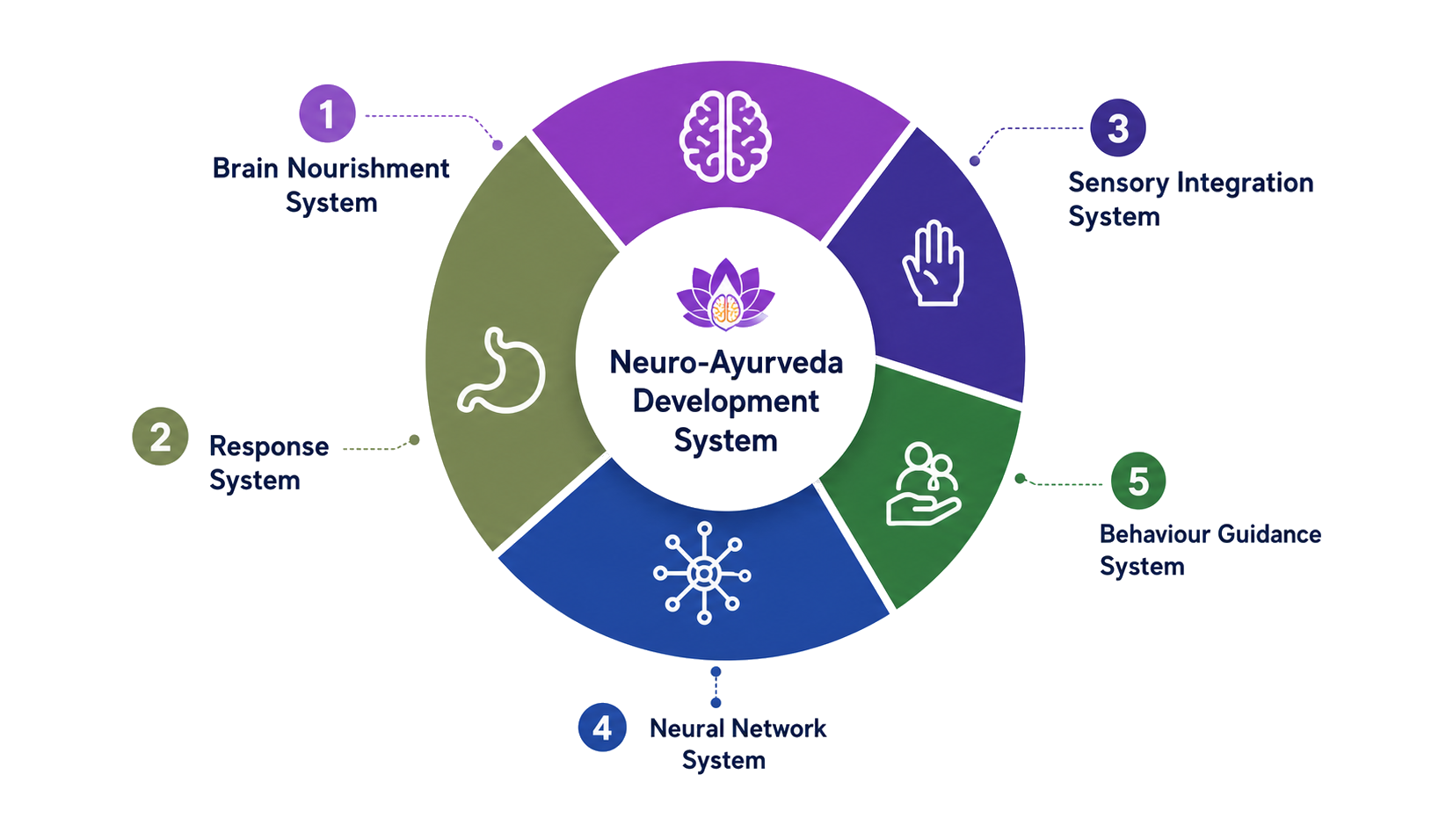
At Manovaidya, child development is seen through the Neuro-Ayurveda Development System, a framework which is structured to gain a perspective beyond the individual symptoms and consider the factors which influence a child's development.
This approach takes a whole-brained view of brain health, nutrition, sensory processing, behaviour, learning and experiences in daily life and how these areas relate to healthy development, rather than just a focus on the diagnosis.
1. Brain Nourishment System
Learning, memory, communication, attention and emotional regulation are supported by healthy brain development. This pillar includes knowledge of factors that can affect healthy brain function and age appropriate development.
2. Gut Response System
Children's nutrition and digestion are important factors in their wellbeing. This pillar takes into account the importance of gut health in relation to nutrition and digestion, and views them as part of a child's developmental profile.
3. Neural Network System
New skills and abilities are acquired by children as a result of learning, repetition and meaningful experiences. This pillar emphasizes enhancing communication, learning, attention and cognitive functioning by providing appropriate developmental guidance.
4. Sensory Integration System
Children see, smell, taste, hear, and touch the world around them. This pillar will support parents in developing an awareness of the impact sensory processing can have on learning, behaviour, emotional regulation and participation in daily activities.
5. Behaviour Guidance System
Child behaviours are frequently a means of communication for needs, feelings or developmental issues. Unlike focusing just on changing behaviour, this pillar aims to teach parents about their children's behaviour patterns while encouraging positive strategies of behaviour guidance that will facilitate emotional development, confidence and healthy development.
How We Support Children
Children are unique and there is no universal program or process for child development.
Manovaidya's support is individualised to reflect the developmental profile, strengths and needs of each child.
Our method involves guidance in areas such as:
Child development assessment
Parent education
Behaviour guidance strategies
Daily routine planning
Lifestyle recommendations
Nutrition and healthy habits
Emotional development
Communication support
Learning support
Progress monitoring and follow-up
We want to equip parents with understanding and guidance that they can use over the years and throughout their child's development, and be there alongside.
Why Parents Across India Choose Manovaidya
Our child-centred and structured approach towards development makes Manovaidya a trusted institute for families from Delhi, Noida, Gurgaon, Faridabad, Ghaziabad and other parts of India.
We specialize in the following aspects of teaching, and these are what parents are attracted to:
Personalised Development Guidance
Holistic Understanding of Brain, Behaviour & Development
Online & In-Clinic Consultations
Long-Term Development Monitoring
Parents of children from Delhi, Noida, Gurgaon, Faridabad, Ghaziabad and other parts of India come to Manovaidya for Child Development Assessments, Developmental Guidance, Autism Treatment, ADHD Treatment and holistic child development care both online and at the clinic.
We want to promote the development of all children to their potential and to provide parents with the clarity, confidence and support they need during the journey of development.
About Dr. Ankush Garg

Autism, ADHD, Child Development & Mental Health Specialist in India
Founder of Manovaidya and Inventor of the Neuro-Ayurveda Development System
Autism, ADHD & Child Development Specialist in India
Dr. Ankush Garg is the Founder of Manovaidya and the developer of the Neuro-Ayurveda Development System.
His work focuses on understanding child development through a holistic perspective that combines brain development, behaviour, communication, learning, nutrition, sensory processing and emotional wellbeing.
Through structured assessments, personalised guidance and continuous follow-up, Dr. Ankush Garg helps families better understand their child's developmental needs and create practical strategies that support healthy growth, learning and everyday functioning.
Based in Delhi NCR, he provides child development consultations for families across India through both online and in-clinic appointments.
Based in Delhi NCR, Dr. Ankush Garg provides Child Development Assessments, Autism & ADHD guidance and holistic developmental support for children across India through the Neuro-Ayurveda Development System.
Frequently Asked Questions (FAQs)
Child development refers to how children physically, emotionally, socially, mentally and behaviourally grow and develop from birth until adolescence. It contains communication, learning, movement, emotional regulation, social interaction and skills of daily living. Children's development varies from person to person and though there are general guidelines to developmental milestones these need to be used as a guide.
Book a Child Development Assessment
Book a Child Development Assessment
Take the First Step Today

Concerned About Your Child's Development?
If you have noticed differences in your child's communication, learning, behaviour, attention, social interaction or developmental milestones, understanding these concerns early is the first step towards providing the right support.
At Manovaidya, we help parents understand their child's unique developmental profile through structured assessment, personalised guidance and the Neuro-Ayurveda Development System.
Let's Understand Your Child's Development Together
Every child deserves the opportunity to grow, learn and thrive at their own pace.
Whether your concerns relate to speech, behaviour, learning, attention, autism, ADHD or general developmental milestones, our team is here to support you with compassionate, evidence-informed and personalised guidance.
Book a structured Child Development Assessment with Manovaidya to better understand your child's communication, learning, behaviour, attention and overall developmental needs.
Social Development